Ch. 15 - Reactions of Carboxylic Acids and Carboxylic Acid Derivatives
Bruice - Organic Chemistry 8th Edition
Bruice8th EditionOrganic ChemistryISBN: 9780135213711Non è quello che usi tu?Cambia libro di testo
Capitolo 15, Problema 12e

Starting with acetyl chloride, what neutral nucleophile would you use to synthesize each of the following compounds?
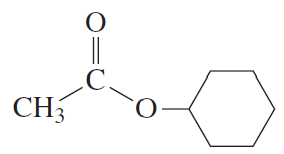
e. Chemical structure of acetyl chloride with a nucleophile leading to a cyclic compound.

Guida verificata passo dopo passo
1
Step 1: Identify the functional group in the target compound. The compound contains an ester functional group, specifically ethyl pentyl ester.
Step 2: Recognize that acetyl chloride (CH3COCl) is an acyl chloride, which is reactive and can be converted into an ester through nucleophilic acyl substitution.
Step 3: Determine the neutral nucleophile required to form the ester. To synthesize the target compound, the nucleophile must be cyclopentanol (C5H9OH), as it provides the cyclopentyl group in the ester.
Step 4: Outline the reaction mechanism. Acetyl chloride reacts with cyclopentanol in the presence of a base (such as pyridine) to neutralize the HCl byproduct. The nucleophilic oxygen of cyclopentanol attacks the carbonyl carbon of acetyl chloride, forming the ester bond.
Step 5: Ensure proper reaction conditions. The reaction should be carried out under anhydrous conditions to prevent hydrolysis of acetyl chloride, and a base like pyridine is used to absorb the HCl formed during the reaction.

Risposta video verificata per un problema simile:

Questa soluzione video è stata consigliata dai nostri tutor come utile per risolvere questo problema.
Durata del video:
5m

Concetti chiave

Ecco i concetti essenziali che devi comprendere per rispondere correttamente alla domanda.

Nucleophilic Acyl Substitution

Nucleophilic acyl substitution is a fundamental reaction in organic chemistry where a nucleophile attacks the carbonyl carbon of an acyl compound, such as an acid chloride, leading to the replacement of a leaving group (like chloride) with the nucleophile. This reaction is crucial for synthesizing various organic compounds, including esters and amides.
Video consigliato:
01:47
Nucleophiles and Electrophiles can react in Substitution Reactions.

Acetyl Chloride

Acetyl chloride is an acyl chloride derived from acetic acid, characterized by the presence of a carbonyl group (C=O) and a chlorine atom. It is a reactive electrophile commonly used in organic synthesis to introduce acetyl groups into nucleophiles, facilitating the formation of esters and other derivatives through nucleophilic acyl substitution.
Video consigliato:
03:13
Acid Chloride Nomenclature

Neutral Nucleophiles

Neutral nucleophiles are species that possess a lone pair of electrons and can donate them to electrophiles without carrying a formal charge. Examples include alcohols, amines, and water. In the context of nucleophilic acyl substitution, a neutral nucleophile can effectively attack the carbonyl carbon of acetyl chloride, leading to the formation of a new compound.
Video consigliato:
08:27
Nucleophilic Addition