Ch. 15 - Reactions of Carboxylic Acids and Carboxylic Acid Derivatives
Bruice - Organic Chemistry 8th Edition
Bruice8th EditionOrganic ChemistryISBN: 9780135213711Non è quello che usi tu?Cambia libro di testo
Capitolo 15, Problema 12f

Starting with acetyl chloride, what neutral nucleophile would you use to synthesize each of the following compounds?
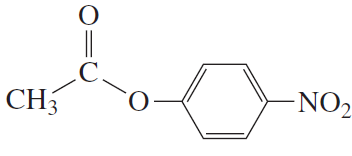
f. Chemical structure of acetyl chloride and a nitrophenol compound, illustrating nucleophilic acyl substitution.

Guida verificata passo dopo passo
1
Step 1: Analyze the target compound. The structure shows an ester functional group, specifically an ethyl ester, attached to a benzene ring substituted with two nitro groups and a methyl group.
Step 2: Identify the starting material, acetyl chloride (CH3COCl). Acetyl chloride is an acyl chloride, which is reactive and can undergo nucleophilic acyl substitution reactions to form esters.
Step 3: Determine the neutral nucleophile required to form the ester. To synthesize the target compound, the nucleophile must be a phenol derivative with the same substitution pattern as the benzene ring in the target compound: a methyl group and two nitro groups.
Step 4: Select the appropriate phenol derivative. The nucleophile should be 2-methyl-4,6-dinitrophenol, as it matches the substitution pattern of the benzene ring in the target compound.
Step 5: Outline the reaction mechanism. Acetyl chloride reacts with 2-methyl-4,6-dinitrophenol in the presence of a base (such as pyridine) to neutralize the HCl byproduct. This results in the formation of the ester bond, yielding the target compound.

Risposta video verificata per un problema simile:

Questa soluzione video è stata consigliata dai nostri tutor come utile per risolvere questo problema.
Durata del video:
4m

Concetti chiave

Ecco i concetti essenziali che devi comprendere per rispondere correttamente alla domanda.

Nucleophilic Substitution

Nucleophilic substitution is a fundamental reaction in organic chemistry where a nucleophile attacks an electrophile, resulting in the replacement of a leaving group. In the context of acetyl chloride, the nucleophile must be neutral and capable of attacking the carbonyl carbon, leading to the formation of a new bond. Understanding this mechanism is crucial for predicting the products of reactions involving acetyl chloride.
Video consigliato:
01:47
Nucleophiles and Electrophiles can react in Substitution Reactions.

Acetyl Chloride Reactivity

Acetyl chloride is a reactive acyl chloride that can undergo nucleophilic acyl substitution due to the presence of the electron-withdrawing chlorine atom. This reactivity allows it to react with various nucleophiles, including alcohols and amines, to form esters and amides, respectively. Recognizing the reactivity of acetyl chloride helps in selecting appropriate nucleophiles for synthesizing desired compounds.
Video consigliato:
01:36
Synthesis of Acid Chlorides

Electrophilic Aromatic Substitution

Electrophilic aromatic substitution (EAS) is a reaction where an electrophile replaces a hydrogen atom on an aromatic ring. In the compound shown, the presence of nitro groups indicates that the aromatic ring is activated for further substitution. Understanding EAS is essential for predicting how the aromatic system will react with nucleophiles, especially when considering the influence of substituents on the ring's reactivity.
Video consigliato:
03:07
EAS Review