
Using the mechanism for the acid-catalyzed hydrolysis of an ester as your guide, write the mechanism—showing all the curved arrows—for the acid-catalyzed reaction of acetic acid and methanol to form methyl acetate. Use HB+ and :B to represent the proton-donating and proton-removing species, respectively.
Ch. 15 - Reactions of Carboxylic Acids and Carboxylic Acid Derivatives
Tutti i libri di testo
Bruice 8th Edition
Ch. 15 - Reactions of Carboxylic Acids and Carboxylic Acid Derivatives
Problema 23a,b
Bruice 8th Edition
Ch. 15 - Reactions of Carboxylic Acids and Carboxylic Acid Derivatives
Problema 23a,bCapitolo 15, Problema 23a,b
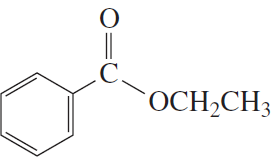
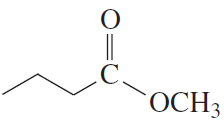
What products are formed from the acid-catalyzed hydrolysis of the following esters?
a. 
b. 
Guida verificata passo dopo passo1
Step 1: Recognize that acid-catalyzed hydrolysis of esters involves breaking the ester bond to form a carboxylic acid and an alcohol. The reaction typically proceeds via nucleophilic attack by water, facilitated by the acid catalyst.
Step 2: Analyze the given ester structure. The ester shown has a carbonyl group (C=O) attached to an ethyl group (CH3CH2O-) and a branched alkyl group (isopropyl group) on the other side of the carbonyl carbon.
Step 3: Identify the products of hydrolysis. The carbonyl carbon will form a carboxylic acid group (-COOH), while the ethyl group will form ethanol (CH3CH2OH) as the alcohol product.
Step 4: Write the chemical equation for the reaction. The ester reacts with water (H2O) in the presence of an acid catalyst to yield the carboxylic acid and alcohol. The general reaction is: RCOOR' + H2O → RCOOH + R'OH.
Step 5: For this specific ester, the products are isobutyric acid (2-methylpropanoic acid) and ethanol. The acid catalyst facilitates protonation of the carbonyl oxygen, making the carbonyl carbon more electrophilic and susceptible to nucleophilic attack by water.

Risposta video verificata per un problema simile:
Questa soluzione video è stata consigliata dai nostri tutor come utile per risolvere questo problema.
Durata del video:
2mConcetti chiave
Ecco i concetti essenziali che devi comprendere per rispondere correttamente alla domanda.
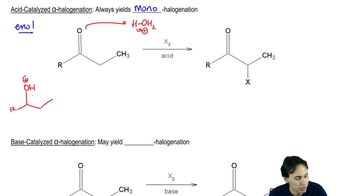
Acid-Catalyzed Hydrolysis
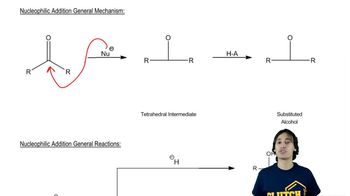
Acid-catalyzed hydrolysis is a reaction where an ester reacts with water in the presence of an acid catalyst, typically a strong acid like sulfuric acid. This process breaks the ester bond, resulting in the formation of an alcohol and a carboxylic acid. The acid catalyst increases the reaction rate by protonating the carbonyl oxygen, making the carbon more electrophilic and susceptible to nucleophilic attack by water.
Video consigliato:
Acid Catalyzed
Esters
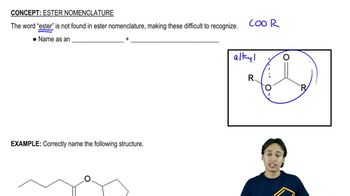
Esters are organic compounds formed from the reaction of an alcohol and a carboxylic acid, characterized by the functional group -COO-. They are often responsible for the flavors and fragrances of fruits and flowers. Understanding the structure of esters is crucial for predicting the products of their hydrolysis, as the specific alcohol and acid components will determine the final products formed during the reaction.
Video consigliato:
Ester Nomenclature
Nucleophilic Attack
Nucleophilic attack is a fundamental concept in organic chemistry where a nucleophile, a species with a high electron density, attacks an electrophile, a species with a partial positive charge. In the context of acid-catalyzed hydrolysis of esters, water acts as the nucleophile that attacks the electrophilic carbon of the protonated ester. This step is critical for breaking the ester bond and forming the corresponding alcohol and carboxylic acid.
Video consigliato:
Nucleophilic Addition
Pratica correlata
Domanda del libro di testo
1656
views
Domanda del libro di testo
Write the mechanism for the acid-catalyzed transesterification of ethyl acetate with methanol.
1295
views
Domanda del libro di testo
In the mechanism for the acid-catalyzed hydrolysis of an ester,
c. what species is HB+ most likely to be in the hydrolysis reaction?
d. what species is HB+ most likely to be in the reverse reaction?
960
views
Domanda del libro di testo
Show the mechanism for the acid-catalyzed formation of 23c starting with the product obtained from its hydrolysis.
1018
views
Domanda del libro di testo
What products are obtained from the following reactions? b. phenyl acetate + excess ethanol + HCl
1577
views
Domanda del libro di testo
Which ester hydrolyzes more rapidly? b. phenyl acetate or benzyl acetate?
1559
views