Ch. 15 - Reactions of Carboxylic Acids and Carboxylic Acid Derivatives
Bruice - Organic Chemistry 8th Edition
Bruice8th EditionOrganic ChemistryISBN: 9780135213711Non è quello che usi tu?Cambia libro di testo
Capitolo 15, Problema 19a

Which ester hydrolyzes more rapidly? a. methyl acetate or phenyl acetate?

Guida verificata passo dopo passo
1
Step 1: Understand the concept of ester hydrolysis. Ester hydrolysis involves breaking the ester bond (C-O bond) in the presence of water or a base/acid catalyst. The rate of hydrolysis depends on the electronic and steric effects of the substituents attached to the ester group.
Step 2: Analyze the structures of methyl acetate and phenyl acetate. Methyl acetate has a methyl group (-CH3) attached to the oxygen atom, while phenyl acetate has a phenyl group (-C6H5) attached to the oxygen atom.
Step 3: Consider the steric effects. The phenyl group is bulkier than the methyl group, which can hinder the approach of water or hydroxide ions to the ester bond, slowing down the hydrolysis reaction.
Step 4: Evaluate the electronic effects. The phenyl group can stabilize the transition state through resonance, but it also withdraws electron density from the ester bond, making it less reactive compared to the methyl group in methyl acetate.
Step 5: Conclude that methyl acetate hydrolyzes more rapidly than phenyl acetate due to the smaller steric hindrance and higher reactivity of the methyl group compared to the phenyl group.

Risposta video verificata per un problema simile:

Questa soluzione video è stata consigliata dai nostri tutor come utile per risolvere questo problema.
Durata del video:
3m

Concetti chiave

Ecco i concetti essenziali che devi comprendere per rispondere correttamente alla domanda.

Ester Hydrolysis

Ester hydrolysis is a chemical reaction where an ester reacts with water to form an alcohol and a carboxylic acid. This reaction can occur under acidic or basic conditions and is crucial in organic chemistry for understanding the reactivity of esters. The rate of hydrolysis can vary significantly based on the structure of the ester, particularly the nature of the alkyl groups attached to the ester functional group.
Video consigliato:
Percorso guidato
0:48
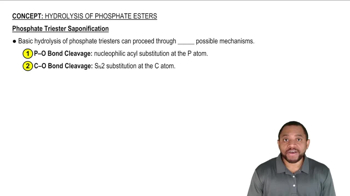
Hydrolysis of Phosphate Esters Concept 2

Electronic Effects

Electronic effects, such as inductive and resonance effects, influence the stability of the transition state during hydrolysis. In the case of methyl acetate versus phenyl acetate, the presence of the phenyl group can stabilize the transition state through resonance, making the hydrolysis slower compared to the more straightforward methyl group. Understanding these effects is essential for predicting the reactivity of different esters.
Video consigliato:
04:29
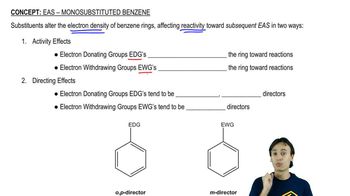
Activity and Directing Effects

Steric Hindrance

Steric hindrance refers to the prevention of chemical reactions due to the spatial arrangement of atoms within a molecule. In the context of ester hydrolysis, bulky groups can hinder the approach of water molecules to the ester bond, slowing down the reaction. Comparing methyl acetate, which has less steric hindrance, to phenyl acetate, which has a larger phenyl group, highlights how steric factors can affect hydrolysis rates.
Video consigliato:
02:53
Understanding steric effects.