Ch. 18 - Reactions of Benzene and Substituted Benzenes
Bruice - Organic Chemistry 8th Edition
Bruice8th EditionOrganic ChemistryISBN: 9780135213711Non è quello che usi tu?Cambia libro di testo
Capitolo 18, Problema 38

Draw resonance contributors for the carbanion that would be formed if meta-chloronitrobenzene were to react with hydroxide ion. Why doesn't the reaction occur?

Guida verificata passo dopo passo
1
Step 1: Understand the structure of meta-chloronitrobenzene. It is a benzene ring with a chlorine atom at the meta position and a nitro group (-NO₂) also at the meta position. The hydroxide ion (OH⁻) is a strong nucleophile and base.
Step 2: Consider the reaction mechanism. If hydroxide ion were to react with meta-chloronitrobenzene, it would likely attack the carbon atom bonded to the chlorine atom, leading to the formation of a carbanion intermediate after the departure of the chloride ion (Cl⁻).
Step 3: Draw the resonance contributors for the carbanion intermediate. The negative charge on the carbon atom can delocalize into the benzene ring. Use curved arrows to show the movement of electrons, and draw resonance structures where the negative charge is distributed to the ortho and para positions relative to the nitro group. The nitro group, being an electron-withdrawing group, stabilizes the negative charge through resonance and inductive effects.
Step 4: Analyze why the reaction does not occur. The chlorine atom in meta-chloronitrobenzene is not a good leaving group under these conditions because the reaction would require breaking a strong C-Cl bond. Additionally, the meta position of the nitro group does not provide optimal stabilization for the carbanion intermediate compared to an ortho or para position.
Step 5: Conclude that the reaction is unfavorable. The combination of a poor leaving group (chlorine) and insufficient stabilization of the carbanion intermediate makes the reaction thermodynamically and kinetically unfavorable. Therefore, hydroxide ion does not react with meta-chloronitrobenzene under normal conditions.

Risposta video verificata per un problema simile:

Questa soluzione video è stata consigliata dai nostri tutor come utile per risolvere questo problema.
Durata del video:
10m

Concetti chiave

Ecco i concetti essenziali che devi comprendere per rispondere correttamente alla domanda.

Resonance Structures

Resonance structures are different Lewis structures for the same molecule that illustrate the delocalization of electrons. In the case of carbanions, resonance can stabilize the negative charge by spreading it over multiple atoms. Understanding how to draw these structures helps predict the stability and reactivity of intermediates in organic reactions.
Video consigliato:
03:04
Drawing Resonance Structures

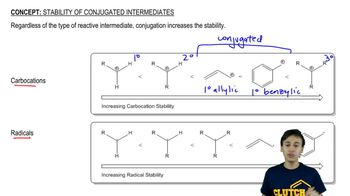
Carbanion Stability

Carbanions are negatively charged carbon species that can be stabilized by electron-withdrawing groups through resonance or inductive effects. The stability of a carbanion is crucial in determining whether a reaction will proceed; more stable carbanions are less reactive. In meta-chloronitrobenzene, the positioning of substituents affects the carbanion's stability and reactivity.
Video consigliato:
04:31
Stability of Conjugated Intermediates

Nucleophilic Substitution Reactions

Nucleophilic substitution reactions involve the replacement of a leaving group by a nucleophile. The reactivity of the substrate and the nature of the nucleophile are key factors in these reactions. In the case of meta-chloronitrobenzene, the electron-withdrawing nitro group decreases the nucleophilicity of hydroxide ion, making the reaction less favorable.
Video consigliato:
01:47
Nucleophiles and Electrophiles can react in Substitution Reactions.