Ch. 18 - Reactions of Benzene and Substituted Benzenes
Bruice - Organic Chemistry 8th Edition
Bruice8th EditionOrganic ChemistryISBN: 9780135213711Non è quello che usi tu?Cambia libro di testo
Capitolo 18, Problema 23b

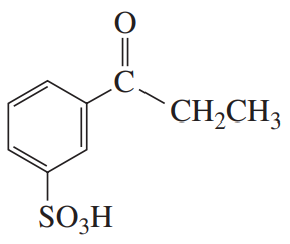
Show how the following compounds can be synthesized from benzene:
b. Chemical structure of a compound derived from benzene, featuring a sulfonic acid and an ethyl group attached to a carbonyl.

Guida verificata passo dopo passo
1
Step 1: Begin with benzene as the starting material. Perform sulfonation by reacting benzene with concentrated sulfuric acid (H₂SO₄) and fuming sulfuric acid (SO₃). This introduces a sulfonic acid group (-SO₃H) onto the benzene ring, forming benzenesulfonic acid.
Step 2: To ensure the correct positioning of the substituents, recognize that the sulfonic acid group is a meta-directing group. This means that subsequent electrophilic substitution reactions will favor the meta position relative to the -SO₃H group.
Step 3: Perform Friedel-Crafts acylation to introduce the acetyl group (-COCH₃) at the meta position. React benzenesulfonic acid with acetyl chloride (CH₃COCl) in the presence of a Lewis acid catalyst such as aluminum chloride (AlCl₃). This reaction forms the desired compound with the acetyl group at the meta position relative to the sulfonic acid group.
Step 4: Carefully isolate and purify the product to ensure the correct compound is obtained. Techniques such as recrystallization or chromatography may be used.
Step 5: Verify the structure of the final product using spectroscopic methods such as NMR or IR to confirm the presence of the sulfonic acid group and the acetyl group in the correct positions on the benzene ring.

Risposta video verificata per un problema simile:

Questa soluzione video è stata consigliata dai nostri tutor come utile per risolvere questo problema.
Durata del video:
5m

Concetti chiave

Ecco i concetti essenziali che devi comprendere per rispondere correttamente alla domanda.

Electrophilic Aromatic Substitution (EAS)

Electrophilic Aromatic Substitution is a fundamental reaction in organic chemistry where an electrophile replaces a hydrogen atom on an aromatic ring. This process is crucial for synthesizing various aromatic compounds, as it allows for the introduction of different functional groups onto the benzene ring. The reaction typically involves the formation of a sigma complex, followed by deprotonation to restore aromaticity.
Video consigliato:
03:07
EAS Review

Sulfonation of Aromatic Compounds

Sulfonation is a specific type of EAS where a sulfonyl group (SO3H) is introduced to an aromatic compound, such as benzene. This reaction is usually carried out using sulfur trioxide (SO3) or fuming sulfuric acid (oleum) as the sulfonating agent. The resulting product, like p-toluene sulfonic acid, is important in various applications, including as a precursor for further chemical transformations.
Video consigliato:
08:19
Intro to Aromaticity

Reactivity of Substituted Aromatic Compounds

The reactivity of substituted aromatic compounds in EAS reactions is influenced by the nature of the substituents already present on the ring. Electron-donating groups, such as alkyl groups, activate the ring and direct incoming electrophiles to the ortho and para positions, while electron-withdrawing groups deactivate the ring and direct electrophiles to the meta position. Understanding these effects is essential for predicting the outcomes of synthetic routes involving aromatic compounds.
Video consigliato:
08:19
Intro to Aromaticity