Ch. 18 - Reactions of Benzene and Substituted Benzenes
Bruice - Organic Chemistry 8th Edition
Bruice8th EditionOrganic ChemistryISBN: 9780135213711Non è quello che usi tu?Cambia libro di testo
Capitolo 18, Problema 35

Which amide bond is hydrolyzed in the first step of the conversion of temozolomide to methyldiazonium?

Guida verificata passo dopo passo
1
Identify the structure of temozolomide and locate the amide bonds present in the molecule. Amide bonds are characterized by the functional group \( \text{C=O} \) (carbonyl) directly bonded to a nitrogen atom (\( \text{N} \)).
Understand the mechanism of hydrolysis. In the first step of the conversion, hydrolysis typically involves the cleavage of an amide bond by the addition of water (\( \text{H}_2\text{O} \)), breaking it into a carboxylic acid derivative and an amine or ammonia.
Analyze the reaction pathway of temozolomide to methyldiazonium. The hydrolysis step specifically targets the amide bond that leads to the formation of the intermediate compound necessary for the generation of methyldiazonium.
Determine which amide bond in temozolomide is positioned to undergo hydrolysis based on the electronic and steric environment. The bond most susceptible to hydrolysis is typically the one that facilitates the formation of a stable intermediate or product.
Conclude that the amide bond hydrolyzed in the first step is the one that directly contributes to the release of the methyldiazonium ion precursor, as this is the key transformation in the reaction pathway.

Risposta video verificata per un problema simile:

Questa soluzione video è stata consigliata dai nostri tutor come utile per risolvere questo problema.
Durata del video:
2m

Concetti chiave

Ecco i concetti essenziali che devi comprendere per rispondere correttamente alla domanda.

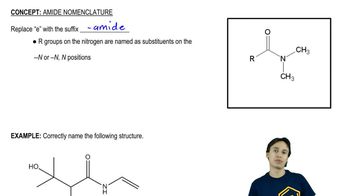
Amide Bond

An amide bond is a functional group characterized by a carbonyl group (C=O) directly attached to a nitrogen atom (N). It is formed through a reaction between a carboxylic acid and an amine, resulting in the release of water. Understanding the structure and reactivity of amide bonds is crucial for predicting their behavior in chemical reactions, such as hydrolysis.
Video consigliato:
01:33
Amide Nomenclature

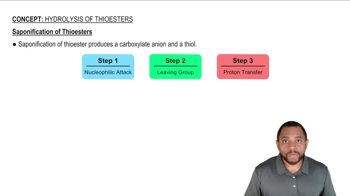
Hydrolysis

Hydrolysis is a chemical reaction involving the breakdown of a compound by water. In the context of amides, hydrolysis typically results in the formation of a carboxylic acid and an amine. This reaction can be catalyzed by acids or bases and is essential for understanding the conversion processes in organic chemistry, including the transformation of temozolomide.
Video consigliato:
Percorso guidato
1:00
Hydrolysis of Thioesters Concept 2

Temozolomide Conversion

Temozolomide is an alkylating agent used in cancer treatment, which undergoes conversion to methyldiazonium through a series of chemical reactions. The initial step involves the hydrolysis of an amide bond, leading to the formation of reactive intermediates. Understanding this conversion is vital for grasping the drug's mechanism of action and its therapeutic implications.
Video consigliato:
04:30
Comparing and contrasting the Alcohol Conversions.