Ch. 2 - Acids and Bases: Central to Understanding Organic Chemistry
Bruice - Organic Chemistry 8th Edition
Bruice8th EditionOrganic ChemistryISBN: 9780135213711Non è quello che usi tu?Cambia libro di testo
Capitolo 2, Problema 4b

What is the conjugate base of each of the following?
1. NH3
2. HBr
3. HNO3
4. H2O

Guida verificata passo dopo passo
1
Step 1: Understand the concept of a conjugate base. A conjugate base is formed when an acid donates a proton (H⁺). The conjugate base will have one less hydrogen atom and a negative charge compared to the original acid.
Step 2: For NH₃ (ammonia), identify the acid and remove one proton (H⁺). The conjugate base will be NH₂⁻. This is because NH₃ loses a hydrogen atom and gains a negative charge.
Step 3: For HBr (hydrobromic acid), remove one proton (H⁺) from the molecule. The conjugate base will be Br⁻, as HBr loses its hydrogen atom and becomes negatively charged.
Step 4: For HNO₃ (nitric acid), remove one proton (H⁺) from the molecule. The conjugate base will be NO₃⁻, as HNO₃ loses its hydrogen atom and gains a negative charge.
Step 5: For H₂O (water), remove one proton (H⁺) from the molecule. The conjugate base will be OH⁻, as H₂O loses a hydrogen atom and becomes negatively charged.

Risposta video verificata per un problema simile:

Questa soluzione video è stata consigliata dai nostri tutor come utile per risolvere questo problema.
Durata del video:
2m

Concetti chiave

Ecco i concetti essenziali che devi comprendere per rispondere correttamente alla domanda.

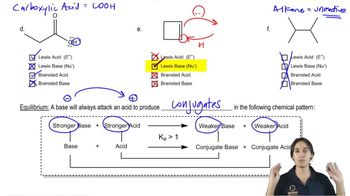
Conjugate Acid-Base Theory

The conjugate acid-base theory, developed by Brønsted and Lowry, defines acids as proton donors and bases as proton acceptors. When an acid donates a proton (H+), it forms its conjugate base, while the base that accepts the proton becomes its conjugate acid. Understanding this relationship is crucial for identifying conjugate pairs in chemical reactions.
Video consigliato:
02:11
Equilibrium constant and conjugates.

Ammonia (NH3) and its Conjugate Base

Ammonia (NH3) acts as a weak base in aqueous solutions. When it accepts a proton, it forms its conjugate acid, ammonium (NH4+). The conjugate base of ammonia, however, is the amide ion (NH2-), which is formed when ammonia donates a proton. Recognizing this transformation is essential for solving the question.
Video consigliato:
03:27
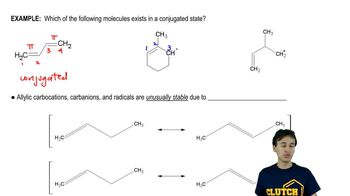
Conjugated states

Strong Acids and Their Conjugate Bases

Strong acids, such as HBr and HNO3, completely dissociate in water, meaning they donate protons readily. The conjugate bases of strong acids are typically very weak and have negligible basicity. For example, the conjugate base of HBr is bromide ion (Br-), and for HNO3, it is nitrate ion (NO3-). Understanding the strength of acids and their corresponding conjugate bases is vital for this question.
Video consigliato:
03:10
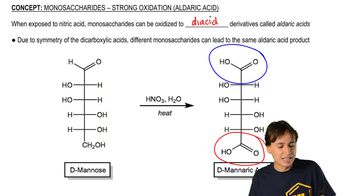
Monosaccharides - Strong Oxidation (Aldaric Acid)