Ch. 20 - The Organic Chemistry of Carbohydrates
Bruice - Organic Chemistry 8th Edition
Bruice8th EditionOrganic ChemistryISBN: 9780135213711Non è quello che usi tu?Cambia libro di testo
Capitolo 20, Problema 34d

What product or products are obtained when d-galactose reacts with each of the following?
d. excess CH3I + Ag2O

Guida verificata passo dopo passo
1
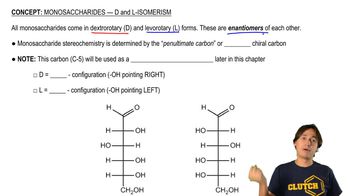
Step 1: Understand the structure of d-galactose. D-galactose is an aldohexose, meaning it has six carbon atoms with an aldehyde functional group at the first carbon and hydroxyl groups (-OH) attached to the other carbons.
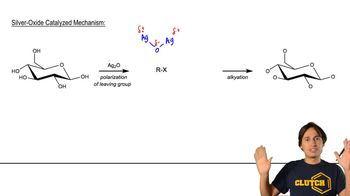
Step 2: Recognize the role of CH3I (methyl iodide) and Ag2O (silver oxide). CH3I is a methylating agent, and Ag2O acts as a base to facilitate the methylation of hydroxyl groups. In the presence of excess CH3I, all hydroxyl groups on d-galactose will be methylated.
Step 3: Identify the reactive sites on d-galactose. The hydroxyl groups on carbons 2, 3, 4, and 6, as well as the hydroxyl group of the hemiacetal (cyclic form), are susceptible to methylation. The aldehyde group in the linear form does not react under these conditions.
Step 4: Predict the product. When all hydroxyl groups are methylated, the product will be a fully methylated derivative of d-galactose. This includes the conversion of all -OH groups to -OCH3 groups.
Step 5: Consider stereochemistry. The stereochemistry of d-galactose remains intact during methylation, as the reaction does not alter the configuration of the carbon atoms. The final product will be a fully methylated d-galactose derivative with the same stereochemical arrangement as the original molecule.

Risposta video verificata per un problema simile:

Questa soluzione video è stata consigliata dai nostri tutor come utile per risolvere questo problema.
Durata del video:
2m

Concetti chiave

Ecco i concetti essenziali che devi comprendere per rispondere correttamente alla domanda.

D-Galactose Structure and Reactivity

D-galactose is a six-carbon aldose sugar with a specific stereochemistry. Understanding its structure is crucial for predicting its reactivity in organic reactions. The hydroxyl groups on the sugar can participate in nucleophilic substitution reactions, which is essential when considering its reaction with methyl iodide (CH3I).
Video consigliato:
06:47
Monosaccharides - D and L Isomerism

Nucleophilic Substitution Reactions

Nucleophilic substitution reactions involve the replacement of a leaving group by a nucleophile. In this case, the hydroxyl group of D-galactose can act as a nucleophile, attacking the electrophilic carbon in methyl iodide (CH3I), leading to the formation of methyl galactoside. Understanding the mechanism of these reactions helps predict the products formed.
Video consigliato:
01:47
Nucleophiles and Electrophiles can react in Substitution Reactions.

Silver Oxide (Ag2O) as a Reactant

Silver oxide (Ag2O) is often used in organic synthesis as a mild oxidizing agent. In the presence of excess Ag2O, the reaction can facilitate the conversion of the formed methyl galactoside into other products, such as the corresponding aldehyde or carboxylic acid, depending on the reaction conditions. Recognizing the role of Ag2O is key to understanding the overall reaction pathway.
Video consigliato:
03:02
Silver Oxide Catalyzed Mechanism