Ch. 22 - Catalysis in Organic Reactions and in Enzymatic Reactions
Bruice - Organic Chemistry 8th Edition
Bruice8th EditionOrganic ChemistryISBN: 9780135213711Non è quello che usi tu?Cambia libro di testo
Capitolo 22, Problema 15

Which of the following amino acid side chains can help remove a proton from the α-carbon of an aldehyde?

Guida verificata passo dopo passo
1
Step 1: Analyze the chemical structures provided in the image. The side chains correspond to amino acids: Structure 1 is glycine, Structure 2 is phenol (tyrosine-like), Structure 3 is imidazole (histidine-like), and Structure 4 is a carboxylate group (glutamate-like).
Step 2: Recall that removing a proton from the α-carbon of an aldehyde requires a base. A base is a molecule or functional group capable of accepting a proton, typically having lone pairs or negative charge.
Step 3: Evaluate the side chains for their ability to act as bases. Structure 3 (imidazole) contains a nitrogen atom with lone pairs, making it a good candidate for proton abstraction. Structure 4 (carboxylate) also has a negatively charged oxygen, which can act as a base.
Step 4: Consider the pKa values of the functional groups. Imidazole has a pKa around 6, making it effective at physiological pH for proton abstraction. Carboxylate groups are also deprotonated at physiological pH, making them strong bases.
Step 5: Conclude that the side chains in Structure 3 (imidazole) and Structure 4 (carboxylate) are capable of removing a proton from the α-carbon of an aldehyde due to their basic properties.

Risposta video verificata per un problema simile:

Questa soluzione video è stata consigliata dai nostri tutor come utile per risolvere questo problema.
Durata del video:
2m

Concetti chiave

Ecco i concetti essenziali che devi comprendere per rispondere correttamente alla domanda.

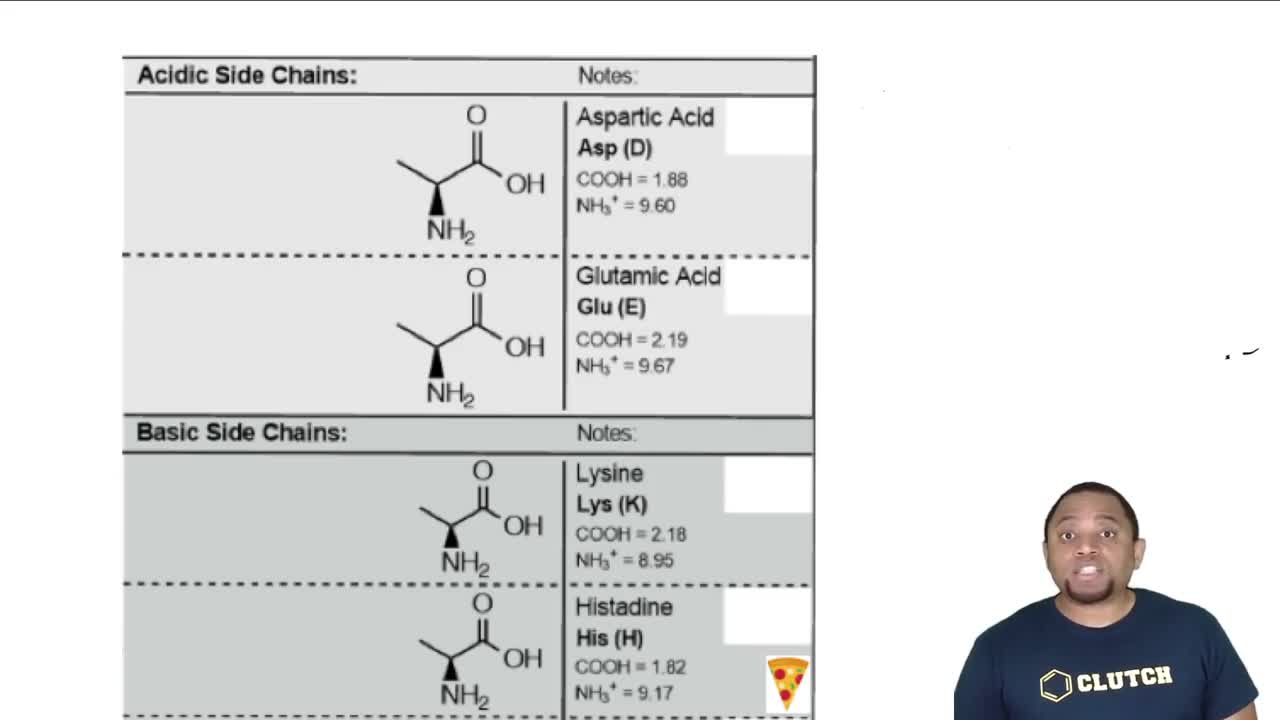
Amino Acid Structure

Amino acids are organic compounds that serve as the building blocks of proteins. Each amino acid consists of a central carbon atom (the alpha carbon) bonded to an amino group, a carboxyl group, a hydrogen atom, and a variable side chain (R group). The properties of the side chain determine the amino acid's characteristics and its role in biochemical reactions.
Video consigliato:
7:19
Charged Amino Acids

Acid-Base Chemistry

Acid-base chemistry involves the transfer of protons (H+) between molecules. In this context, an amino acid can act as a base if its side chain has a functional group capable of accepting a proton. Understanding the pKa values of these side chains is crucial, as it indicates their ability to donate or accept protons under physiological conditions.
Video consigliato:
02:49
The Lewis definition of acids and bases.

Reactivity of Aldehydes

Aldehydes are organic compounds characterized by a carbonyl group (C=O) bonded to at least one hydrogen atom. They are reactive due to the electrophilic nature of the carbon atom in the carbonyl group, making them susceptible to nucleophilic attack. Certain amino acid side chains can facilitate the removal of a proton from the alpha carbon of an aldehyde, influencing the reactivity and stability of the compound.
Video consigliato:
01:34
Name the aldehyde