Ch. 4 - Isomers: The Arrangement of Atoms in Space
Bruice - Organic Chemistry 8th Edition
Bruice8th EditionOrganic ChemistryISBN: 9780135213711Non è quello che usi tu?Cambia libro di testo
Capitolo 4, Problema 92c,d

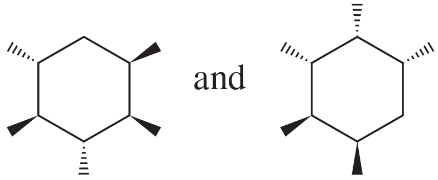
Are the following pairs identical, enantiomers, diastereomers, or constitutional isomers?
c.
d.

Guida verificata passo dopo passo
1
Step 1: Analyze the first pair of molecules (c). Observe the stereochemistry of the substituents on the cyclohexane ring. Note the orientation of the substituents (wedge and dash) to determine if they are identical, enantiomers, diastereomers, or constitutional isomers.
Step 2: Compare the spatial arrangement of the substituents in the first pair. If all substituents are the same and in the same positions, the molecules are identical. If the substituents are mirror images but not superimposable, they are enantiomers. If they are not mirror images but differ in stereochemistry, they are diastereomers. If the connectivity of atoms differs, they are constitutional isomers.
Step 3: Analyze the second pair of molecules (d). Observe the stereochemistry of the substituents on the cyclohexane ring. Pay attention to the orientation of the substituents (wedge and dash) and their positions on the ring.
Step 4: Compare the spatial arrangement of the substituents in the second pair. Use the same criteria as in Step 2 to classify the relationship between the molecules (identical, enantiomers, diastereomers, or constitutional isomers).
Step 5: Summarize the findings for both pairs (c and d) based on the stereochemical analysis. Ensure clarity in distinguishing between identical molecules, enantiomers, diastereomers, and constitutional isomers.

Risposta video verificata per un problema simile:

Questa soluzione video è stata consigliata dai nostri tutor come utile per risolvere questo problema.
Durata del video:
5m

Concetti chiave

Ecco i concetti essenziali che devi comprendere per rispondere correttamente alla domanda.

Stereoisomers

Stereoisomers are compounds that have the same molecular formula and connectivity of atoms but differ in the spatial arrangement of their atoms. This category includes enantiomers and diastereomers, which are crucial for understanding the relationships between different isomers in organic chemistry.
Video consigliato:
01:58
Determining when molecules are stereoisomers.

Enantiomers

Enantiomers are a specific type of stereoisomer that are non-superimposable mirror images of each other. They typically arise in molecules with chiral centers, where the arrangement of substituents around the chiral carbon leads to two distinct forms that can exhibit different optical activities.
Video consigliato:
03:23
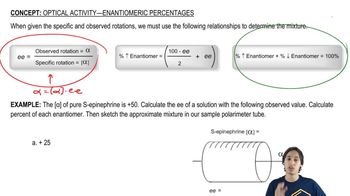
How to solve for the percentage of each enantiomer.

Diastereomers

Diastereomers are stereoisomers that are not mirror images of each other. They occur when a molecule has two or more chiral centers, leading to multiple stereoisomeric forms. Unlike enantiomers, diastereomers can have different physical properties, such as boiling points and solubilities.
Video consigliato:
03:44
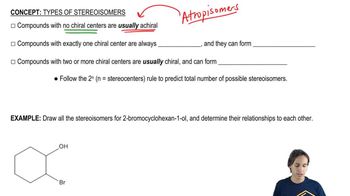
Using chiral centers to predict types of stereoisomers.