Ch. 4 - Isomers: The Arrangement of Atoms in Space
Bruice - Organic Chemistry 8th Edition
Bruice8th EditionOrganic ChemistryISBN: 9780135213711Non è quello che usi tu?Cambia libro di testo
Capitolo 4, Problema 84e,f

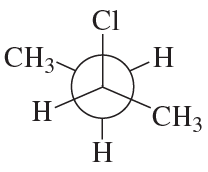
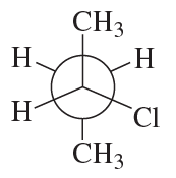
Indicate whether each of the following structures is (R)-2-chlorobutane or (S)-2-chlorobutane:
e. Structural representation of 2-chlorobutane showing its chirality with labeled groups for R and S configuration analysis.
f. Structural representation of 2-chlorobutane showing hydrogen and chlorine atoms for R and S configuration analysis.

Guida verificata passo dopo passo
1
Step 1: Identify the chiral center in the molecule. In both structures, the chiral center is the carbon atom bonded to four different groups: a bromine atom (Br), a hydrogen atom (H), a methyl group (CH3), and an ethyl group (CH2CH3).
Step 2: Assign priorities to the substituents based on the Cahn-Ingold-Prelog priority rules. The substituent with the highest atomic number gets the highest priority. Here, Br > CH2CH3 > CH3 > H.
Step 3: Orient the molecule so that the lowest priority group (H) is pointing away from you. This is crucial for determining the configuration.
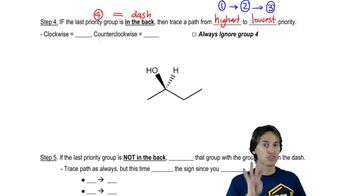
Step 4: Trace the path from the highest priority group (1) to the second (2) and then to the third (3). If the path is clockwise, the configuration is (R). If the path is counterclockwise, the configuration is (S).
Step 5: Apply the above steps to each structure (a and b) individually to determine whether it is (R)-2-chlorobutane or (S)-2-chlorobutane.

Risposta video verificata per un problema simile:

Questa soluzione video è stata consigliata dai nostri tutor come utile per risolvere questo problema.
Durata del video:
8m

Concetti chiave

Ecco i concetti essenziali che devi comprendere per rispondere correttamente alla domanda.

Chirality

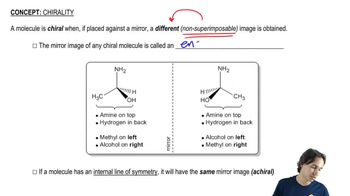
Chirality refers to the geometric property of a molecule that makes it non-superimposable on its mirror image. A chiral molecule typically has a carbon atom bonded to four different substituents, leading to two distinct configurations known as enantiomers. In the case of 2-chlorobutane, the chirality arises from the presence of the chlorine atom and the different alkyl groups attached to the chiral carbon.
Video consigliato:
05:10
What is chirality?

Cahn-Ingold-Prelog Priority Rules

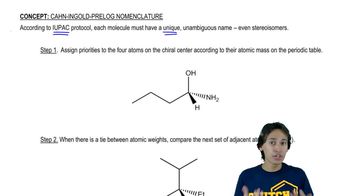
The Cahn-Ingold-Prelog (CIP) priority rules are a set of guidelines used to assign priorities to the substituents attached to a chiral center. According to these rules, the substituents are ranked based on atomic number; higher atomic numbers receive higher priority. If two substituents have the same atomic number, the next atoms in the chain are considered until a difference is found, which is crucial for determining the (R) or (S) configuration.
Video consigliato:
01:48
Why stereoisomers need their own naming system.

R and S Configurations

The (R) and (S) designations are used to describe the absolute configuration of chiral centers in molecules. To determine whether a chiral center is (R) or (S), one must first assign priorities to the substituents using the CIP rules, then orient the molecule so that the lowest priority substituent is at the back. If the sequence from highest to lowest priority is clockwise, the configuration is (R); if counterclockwise, it is (S).
Video consigliato:
03:07
R and S Naming- Step 4