Ch. 8 - Delocalized Electrons: Their Effect on Stability, pKa, and the Products of a Reaction • Aromaticity and Electronic Effects: An Introduction to the Reactions of Benzene
Bruice - Organic Chemistry 8th Edition
Bruice8th EditionOrganic ChemistryISBN: 9780135213711Non è quello che usi tu?Cambia libro di testo
Capitolo 8, Problema 29

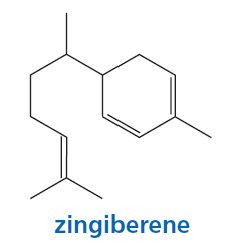
Which of the double bonds in zingiberene, the compound responsible for the aroma of ginger, is most reactive in an electrophilic addition reaction with HBr?
Chemical structure of zingiberene, highlighting its double bonds for reactivity in electrophilic addition reactions.

Guida verificata passo dopo passo
1
Identify the structure of zingiberene from the image. Zingiberene contains three double bonds labeled as 1, 2, and 3. These double bonds are located in different positions within the molecule, and their reactivity in electrophilic addition reactions depends on their electronic environment and steric factors.
Understand the mechanism of electrophilic addition of HBr. In this reaction, the π-electrons of the double bond attack the electrophilic hydrogen (H⁺) of HBr, forming a carbocation intermediate. The stability of this carbocation intermediate is a key factor in determining which double bond is most reactive.
Analyze the stability of the carbocation intermediates formed by each double bond. Double bond 1 forms a secondary carbocation, double bond 2 forms a tertiary carbocation, and double bond 3 forms a primary carbocation. Tertiary carbocations are the most stable due to hyperconjugation and inductive effects, followed by secondary and then primary carbocations.
Consider steric hindrance and accessibility. Double bond 2 is located in a less sterically hindered position compared to double bond 1 and double bond 3, making it more accessible for the electrophilic addition reaction.
Conclude that double bond 2 is the most reactive in an electrophilic addition reaction with HBr because it forms the most stable carbocation (tertiary) and is in a relatively accessible position within the molecule.

Risposta video verificata per un problema simile:

Questa soluzione video è stata consigliata dai nostri tutor come utile per risolvere questo problema.
Durata del video:
4m

Concetti chiave

Ecco i concetti essenziali che devi comprendere per rispondere correttamente alla domanda.

Electrophilic Addition Reactions

Electrophilic addition reactions involve the addition of an electrophile to a nucleophile, typically across a double bond. In alkenes, the π bond is broken, allowing the electrophile to bond with one carbon atom while a nucleophile can bond with the other. The reactivity of the double bond is influenced by factors such as sterics and electronic effects, which determine how readily the double bond can react with electrophiles like HBr.
Video consigliato:
05:39
Features of Addition Mechanisms.

Stability of Carbocation Intermediates

During electrophilic addition, a carbocation intermediate is often formed. The stability of this carbocation is crucial for determining the reactivity of the double bond. More stable carbocations, such as tertiary carbocations, are formed from more substituted double bonds, making those bonds more reactive in electrophilic addition reactions. Understanding the stability of these intermediates helps predict which double bond will react preferentially.
Video consigliato:
05:58
Determining Carbocation Stability

Regioselectivity in Electrophilic Addition

Regioselectivity refers to the preference of a chemical reaction to yield one structural isomer over others when multiple possibilities exist. In the context of electrophilic addition to alkenes, the Markovnikov rule often applies, stating that the more substituted carbon will bond with the electrophile. This concept is essential for predicting the outcome of the reaction with HBr in zingiberene, as it helps identify which double bond will be more reactive based on the structure of the compound.
Video consigliato:
09:23
1,2 vs 1,4 Addition