
Ch. 10 - Alkynes: Electrophilic Addition and Redox Reactions
Mullins - Organic Chemistry: A Learner Centered Approach 1st Edition
Mullins1st EditionOrganic Chemistry: A Learner Centered ApproachISBN: 9780137566471Non è quello che usi tu?Cambia libro di testo
Capitolo 9, Problema 6f

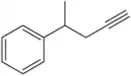
Identify the following alkynes as terminal (T), internal/symmetrical (IS), or internal/unsymmetrical (IU).
(f)

Guida verificata passo dopo passo
1
Step 1: Recall the definitions of terminal, internal/symmetrical, and internal/unsymmetrical alkynes. A terminal alkyne (T) has the triple bond at the end of the carbon chain, with at least one hydrogen atom directly attached to one of the sp-hybridized carbons. An internal/symmetrical alkyne (IS) has the triple bond between two carbons that are symmetrically substituted. An internal/unsymmetrical alkyne (IU) has the triple bond between two carbons that are asymmetrically substituted.
Step 2: Examine the structure of the given alkyne (f). Identify the position of the triple bond within the carbon chain. Determine whether the triple bond is at the end of the chain or between two carbons in the middle of the chain.
Step 3: If the triple bond is at the end of the chain and one of the sp-hybridized carbons is bonded to a hydrogen atom, classify the alkyne as terminal (T).
Step 4: If the triple bond is between two carbons in the middle of the chain, check the substituents on both carbons. If the substituents are identical or symmetrical, classify the alkyne as internal/symmetrical (IS).
Step 5: If the triple bond is between two carbons in the middle of the chain and the substituents on the carbons are different or asymmetrical, classify the alkyne as internal/unsymmetrical (IU).

Risposta video verificata per un problema simile:

Questa soluzione video è stata consigliata dai nostri tutor come utile per risolvere questo problema.
Durata del video:
1m

Concetti chiave

Ecco i concetti essenziali che devi comprendere per rispondere correttamente alla domanda.

Alkynes

Alkynes are hydrocarbons that contain at least one carbon-carbon triple bond. They are unsaturated compounds, which means they have fewer hydrogen atoms than alkanes and alkenes with the same number of carbon atoms. The general formula for alkynes is CnH2n-2, where n is the number of carbon atoms. Understanding the structure of alkynes is crucial for identifying their types.
Video consigliato:
09:11
Alkyne Hydration

Terminal vs. Internal Alkynes

Terminal alkynes have the triple bond located at the end of the carbon chain, meaning one end of the molecule is a carbon atom bonded to a hydrogen atom. In contrast, internal alkynes have the triple bond located between two carbon atoms, with no hydrogen atoms directly attached to the carbons involved in the triple bond. This distinction is essential for classifying alkynes correctly.
Video consigliato:
02:43
Anti-Markovnikov addition of alcohols to terminal alkynes yields aldehydes

Symmetrical vs. Unsymmetrical Alkynes

Symmetrical internal alkynes have identical groups attached to both sides of the triple bond, while unsymmetrical internal alkynes have different groups on either side. This classification affects the physical and chemical properties of the compounds, making it important to recognize the symmetry when identifying and naming alkynes.
Video consigliato:
09:11
Alkyne Hydration