Ch. 10 - Alkynes: Electrophilic Addition and Redox Reactions
Mullins - Organic Chemistry: A Learner Centered Approach 1st Edition
Mullins1st EditionOrganic Chemistry: A Learner Centered ApproachISBN: 9780137566471Non è quello che usi tu?Cambia libro di testo
Capitolo 9, Problema 47c

Suggest a method for synthesizing the following alkynes using an alkyne and an alkyl halide. [There are two correct answers for each product.]
(c)

Guida verificata passo dopo passo
1
Step 1: Analyze the target molecule. The structure contains an alkyne functional group and a cyclopropyl group attached to the alkyne. This suggests that the synthesis will involve coupling an alkyne with an alkyl halide.
Step 2: Choose the alkyne precursor. The terminal alkyne (ethynyl group) can be used as the starting material. Deprotonate the terminal alkyne using a strong base such as sodium amide (NaNH₂) to generate the acetylide anion.
Step 3: Select the alkyl halide. The cyclopropyl group can be introduced using cyclopropyl bromide or cyclopropyl iodide as the alkyl halide. The acetylide anion will act as a nucleophile and perform an SN2 reaction with the alkyl halide.
Step 4: Perform the coupling reaction. Mix the acetylide anion with the alkyl halide under appropriate conditions (e.g., in a polar aprotic solvent like DMSO or acetone) to form the desired alkyne product.
Step 5: Verify the product. Ensure that the reaction conditions are optimized to avoid side reactions, and confirm the structure of the synthesized alkyne using spectroscopic techniques such as NMR or IR.

Risposta video verificata per un problema simile:

Questa soluzione video è stata consigliata dai nostri tutor come utile per risolvere questo problema.
Durata del video:
6m

Concetti chiave

Ecco i concetti essenziali che devi comprendere per rispondere correttamente alla domanda.

Alkynes

Alkynes are hydrocarbons that contain at least one carbon-carbon triple bond. They are unsaturated compounds and are characterized by the general formula CnH2n-2. The presence of the triple bond significantly influences their reactivity, making them suitable for various organic reactions, including nucleophilic substitutions and additions.
Video consigliato:
09:11
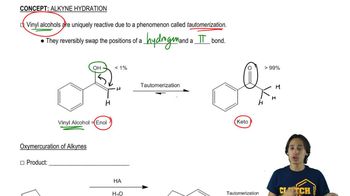
Alkyne Hydration

Nucleophilic Substitution Reactions

Nucleophilic substitution reactions involve the replacement of a leaving group in a molecule with a nucleophile. In the context of synthesizing alkynes, alkyl halides can serve as substrates for these reactions, where the nucleophile attacks the carbon atom bonded to the halide, leading to the formation of new carbon-carbon bonds.
Video consigliato:
01:47
Nucleophiles and Electrophiles can react in Substitution Reactions.

Synthesis Strategies

Synthesis strategies in organic chemistry refer to the methods used to construct complex molecules from simpler ones. For alkynes, common strategies include using alkyl halides in nucleophilic substitution reactions with terminal alkynes or employing coupling reactions such as the Sonogashira reaction, which combines an alkyne with an aryl or vinyl halide to form new carbon-carbon bonds.
Video consigliato:
Percorso guidato
1:16
Synthesis of Amino Acids: Strecker Synthesis Example 1