Ch. 10 - Alkynes: Electrophilic Addition and Redox Reactions
Mullins - Organic Chemistry: A Learner Centered Approach 1st Edition
Mullins1st EditionOrganic Chemistry: A Learner Centered ApproachISBN: 9780137566471Non è quello che usi tu?Cambia libro di testo
Capitolo 9, Problema 4

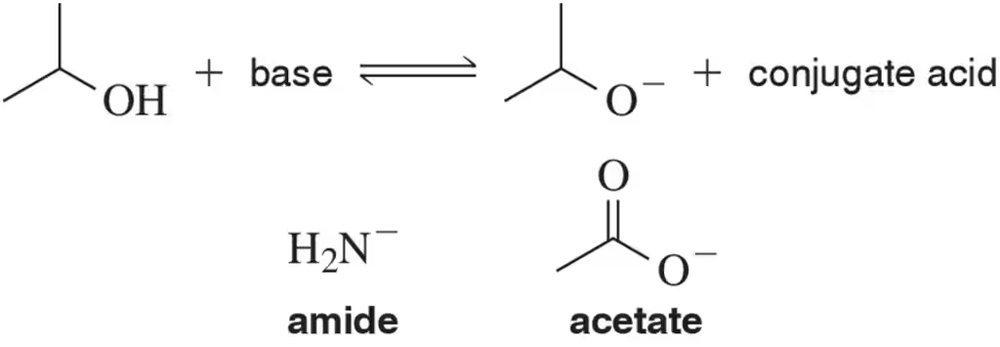
Would amide or acetate most easily deprotonate an alcohol to make the alkoxide anion? Calculate Keq for each possibility.
Chemical reaction diagram comparing amide and acetate for deprotonating an alcohol to form alkoxide anion.

Guida verificata passo dopo passo
1
Identify the two bases in the problem: amide (NH₂⁻) and acetate (CH₃COO⁻). These bases will react with the alcohol (ROH) to form the alkoxide anion (RO⁻) and their respective conjugate acids.
Write the acid-base equilibrium reactions for each case: (1) Amide reacting with alcohol: NH₂⁻ + ROH ⇌ RO⁻ + NH₃, and (2) Acetate reacting with alcohol: CH₃COO⁻ + ROH ⇌ RO⁻ + CH₃COOH.
Determine the pKa values of the acids involved: (1) For the amide reaction, the conjugate acid is NH₃ (pKa ≈ 38), and the alcohol has a typical pKa of ~16-18. (2) For the acetate reaction, the conjugate acid is acetic acid (CH₃COOH, pKa ≈ 4.76), and the alcohol again has a pKa of ~16-18.
Calculate the equilibrium constant (K_eq) for each reaction using the relationship: K_eq = 10^(pKa(conjugate acid of base) - pKa(acid being deprotonated)). For the amide reaction, K_eq = 10^(38 - 16). For the acetate reaction, K_eq = 10^(4.76 - 16).
Compare the K_eq values for the two reactions. The base that produces the larger K_eq will more effectively deprotonate the alcohol, as it drives the equilibrium further toward the formation of the alkoxide anion.

Risposta video verificata per un problema simile:

Questa soluzione video è stata consigliata dai nostri tutor come utile per risolvere questo problema.
Durata del video:
5m

Concetti chiave

Ecco i concetti essenziali che devi comprendere per rispondere correttamente alla domanda.

Acidity and Basicity

Acidity refers to the tendency of a compound to donate protons (H+), while basicity is the ability to accept protons. In organic chemistry, the strength of acids and bases can be compared using pKa values, where lower pKa indicates a stronger acid. Understanding the relative acidity of amides and acetates is crucial for predicting which will more readily deprotonate an alcohol to form an alkoxide anion.
Video consigliato:
06:21
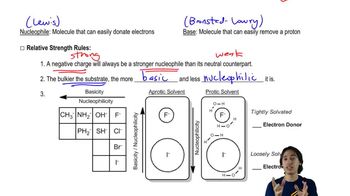
Understanding the difference between basicity and nucleophilicity.

Equilibrium Constant (K_eq)

The equilibrium constant (K_eq) quantifies the ratio of the concentrations of products to reactants at equilibrium for a given reaction. It is calculated using the formula K_eq = [products]/[reactants]. In this context, calculating K_eq for the deprotonation of alcohols by amides and acetates will help determine which reaction is more favorable and thus which compound is more effective in forming alkoxide anions.
Video consigliato:
02:19
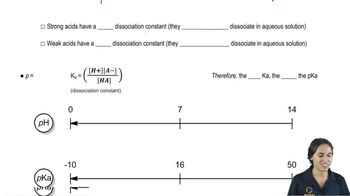
The relationship between equilibrium constant and pKa.

Alkoxide Ion Formation

An alkoxide ion is formed when an alcohol loses a proton, resulting in a negatively charged species. This process is significant in organic reactions, particularly in nucleophilic substitutions and eliminations. The stability of the alkoxide ion and the ability of the deprotonating agent (amide or acetate) to stabilize the resulting charge will influence the ease of this deprotonation process.
Video consigliato:
Percorso guidato
3:39
Metal Ion Catalysis Concept 1