Ch. 11 - Properties and Synthesis of Alkyl Halides: Radical Reactions
Mullins - Organic Chemistry: A Learner Centered Approach 1st Edition
Mullins1st EditionOrganic Chemistry: A Learner Centered ApproachISBN: 9780137566471Non è quello che usi tu?Cambia libro di testo
Capitolo 10, Problema 16c

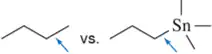
Based on the stability of the radicals produced, predict which bond in each pair would have the higher bond-dissociation energy.
(c) Chemical structure comparison: two molecules with arrows indicating bonds, one with a tin (Sn) atom, assessing bond-dissociation energy.

Guida verificata passo dopo passo
1
Understand the concept of bond-dissociation energy: It is the energy required to break a bond in a molecule, resulting in the formation of radicals. The stability of the resulting radicals plays a crucial role in determining the bond-dissociation energy.
Identify the types of radicals formed: When a bond is broken, two radicals are formed. The stability of these radicals can be influenced by factors such as resonance, hyperconjugation, and the presence of electron-withdrawing or electron-donating groups.
Compare the stability of the radicals: More stable radicals result in lower bond-dissociation energy because less energy is required to form them. Conversely, less stable radicals result in higher bond-dissociation energy.
Evaluate the factors affecting radical stability: Consider the electronic effects such as resonance stabilization, hyperconjugation, and inductive effects. Radicals that are stabilized by resonance or hyperconjugation will generally have lower bond-dissociation energies.
Predict the bond with higher bond-dissociation energy: Based on the stability analysis, the bond that forms less stable radicals upon dissociation will have a higher bond-dissociation energy. This is because more energy is required to break the bond and form less stable radicals.

Risposta video verificata per un problema simile:

Questa soluzione video è stata consigliata dai nostri tutor come utile per risolvere questo problema.
Durata del video:
2m

Concetti chiave

Ecco i concetti essenziali che devi comprendere per rispondere correttamente alla domanda.

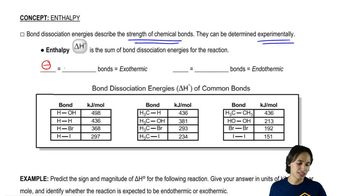
Bond-Dissociation Energy

Bond-dissociation energy is the energy required to break a bond in a molecule, resulting in the formation of radicals. It is a measure of bond strength; higher bond-dissociation energy indicates a stronger bond. Understanding this concept helps predict which bonds are more stable and resistant to breaking.
Video consigliato:
04:09
How to calculate enthalpy using bond dissociation energies.

Radical Stability

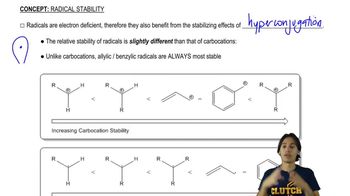
Radical stability refers to the ability of a radical to exist without undergoing further reactions. Stability is influenced by factors such as resonance, hyperconjugation, and the electronegativity of atoms involved. More stable radicals are typically formed from bonds with lower bond-dissociation energies.
Video consigliato:
03:43
The radical stability trend.

Resonance and Hyperconjugation

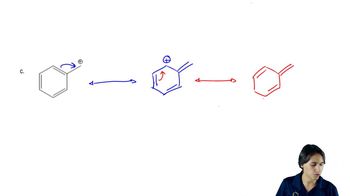
Resonance and hyperconjugation are phenomena that stabilize radicals. Resonance involves the delocalization of electrons across adjacent atoms, while hyperconjugation involves the interaction of sigma bonds with adjacent pi systems or empty orbitals. These effects increase radical stability, influencing bond-dissociation energy predictions.
Video consigliato:
03:04
Drawing Resonance Structures