Ch. 11 - Properties and Synthesis of Alkyl Halides: Radical Reactions
Mullins - Organic Chemistry: A Learner Centered Approach 1st Edition
Mullins1st EditionOrganic Chemistry: A Learner Centered ApproachISBN: 9780137566471Non è quello che usi tu?Cambia libro di testo
Capitolo 10, Problema 26

HBr and peroxides are also used to generate 1-bromo-1-alkenes. Suggest a starting reactant that would successfully undergo this reaction.
Reaction scheme showing HBr and peroxides converting an unspecified reactant to 1-bromo-1-alkene.

Guida verificata passo dopo passo
1
Identify the reaction type: The presence of HBr and peroxides indicates an anti-Markovnikov addition reaction via a free radical mechanism. This reaction typically occurs with alkenes as starting materials.
Understand the product: The problem specifies the formation of a 1-bromo-1-alkene. This suggests that the bromine atom will attach to the less substituted carbon of the double bond, leaving the more substituted carbon as part of the alkene.
Choose a suitable starting reactant: To generate a 1-bromo-1-alkene, the starting material should be a terminal alkyne. Terminal alkynes are ideal because the addition of HBr in the presence of peroxides will result in the desired anti-Markovnikov addition.
Explain the mechanism: In the presence of peroxides, the reaction proceeds via a free radical mechanism. The bromine radical adds to the less substituted carbon of the triple bond, forming a vinyl radical. This radical then reacts with another HBr molecule to form the final product.
Verify the structure: Ensure that the starting terminal alkyne has the correct structure to yield a 1-bromo-1-alkene after the reaction. For example, propyne (CH₃-C≡CH) would be a suitable starting material.

Risposta video verificata per un problema simile:

Questa soluzione video è stata consigliata dai nostri tutor come utile per risolvere questo problema.

Concetti chiave

Ecco i concetti essenziali che devi comprendere per rispondere correttamente alla domanda.

Radical Mechanism

The reaction of alkenes with HBr in the presence of peroxides follows a radical mechanism, which involves the formation of bromine radicals. This mechanism differs from the ionic pathway, as it leads to anti-Markovnikov addition, where the bromine atom adds to the less substituted carbon of the alkene. Understanding this mechanism is crucial for predicting the products of the reaction.
Video consigliato:
03:28
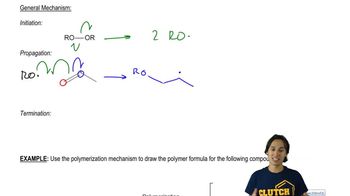
The mechanism of Radical Polymerization.

Alkene Reactivity

Alkenes are unsaturated hydrocarbons characterized by at least one carbon-carbon double bond. Their reactivity is influenced by the stability of the double bond and the substituents attached to the carbons. A suitable starting reactant for generating 1-bromo-1-alkenes should ideally be a terminal alkene, which can effectively undergo radical addition with HBr.
Video consigliato:
Percorso guidato
2:09
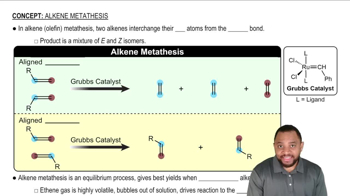
Alkene Metathesis Concept 1

Anti-Markovnikov's Rule

Anti-Markovnikov's Rule states that in the addition of HX to alkenes, the hydrogen atom will add to the more substituted carbon atom, while the halide (in this case, bromine) will add to the less substituted carbon. This rule is particularly relevant in reactions involving peroxides, as they promote the formation of radicals that lead to this specific product distribution, which is essential for identifying the correct starting reactant.
Video consigliato:
03:19
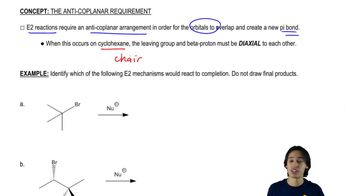
The Anti-Coplanar Requirement