Ch. 11 - Properties and Synthesis of Alkyl Halides: Radical Reactions
Mullins - Organic Chemistry: A Learner Centered Approach 1st Edition
Mullins1st EditionOrganic Chemistry: A Learner Centered ApproachISBN: 9780137566471Non è quello che usi tu?Cambia libro di testo
Capitolo 10, Problema 31c

In the following allylic radicals, identify the carbon where the new C― Br bond is most likely to form in the second propagation step.
(c) Allylic radical structures with arrows indicating resonance, showing potential sites for C-Br bond formation.

Guida verificata passo dopo passo
1
Identify the structure of the allylic radical. An allylic radical is a radical in which the unpaired electron is located on a carbon atom adjacent to a carbon-carbon double bond.
Examine the resonance structures of the allylic radical. Resonance structures are different ways of drawing the same molecule, showing the delocalization of electrons. For allylic radicals, the unpaired electron can be delocalized over the allylic position and the adjacent double bond.
Determine the stability of each resonance structure. The more stable the resonance structure, the more likely it is to contribute to the actual structure of the radical. Stability is often influenced by factors such as the degree of substitution of the radical center and the presence of electron-donating or withdrawing groups.
Identify the carbon atom in the resonance structure where the unpaired electron is most stable. This is typically the carbon atom where the new C―Br bond is most likely to form, as the radical will react at the site of highest electron density.
Consider the regioselectivity of the reaction. In many cases, the formation of the C―Br bond will occur at the more substituted carbon atom due to the increased stability of the resulting radical or carbocation intermediate.

Risposta video verificata per un problema simile:

Questa soluzione video è stata consigliata dai nostri tutor come utile per risolvere questo problema.
Durata del video:
6m

Concetti chiave

Ecco i concetti essenziali che devi comprendere per rispondere correttamente alla domanda.

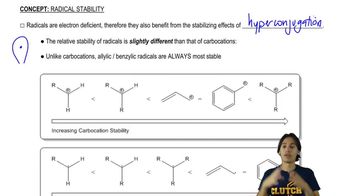
Allylic Radical Stability

Allylic radicals are stabilized by resonance, which allows the unpaired electron to be delocalized over multiple atoms. This delocalization increases the stability of the radical, making allylic positions more reactive in radical reactions. Understanding this stability is crucial for predicting where new bonds will form.
Video consigliato:
03:43
The radical stability trend.

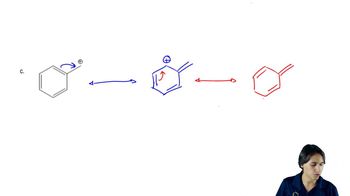
Resonance Structures

Resonance structures are different ways of drawing the same molecule, showing the delocalization of electrons. In allylic radicals, resonance allows the radical to be spread over multiple carbon atoms, influencing where reactions, such as the formation of a new C-Br bond, are most likely to occur.
Video consigliato:
03:04
Drawing Resonance Structures

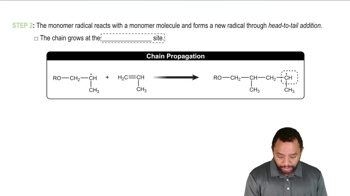
Radical Propagation Step

The propagation step in radical reactions involves the radical reacting with a molecule to form a new radical and a new bond. In the context of allylic radicals, the most stable radical position, often determined by resonance, is where the new bond, such as C-Br, is likely to form during the second propagation step.
Video consigliato:
Percorso guidato
1:01
Radical Polymerization Concept 3