Ch. 11 - Properties and Synthesis of Alkyl Halides: Radical Reactions
Mullins - Organic Chemistry: A Learner Centered Approach 1st Edition
Mullins1st EditionOrganic Chemistry: A Learner Centered ApproachISBN: 9780137566471Non è quello che usi tu?Cambia libro di testo
Capitolo 10, Problema 54

The following ethers are ranked according to their ability to form explosive peroxides. Explain this ranking based on your knowledge of the reaction mechanism.
Ethers ranked by susceptibility to oxidation, from most to least: tert-butyl, ethyl, methyl, isopropyl.

Guida verificata passo dopo passo
1
Understand the structure of ethers: Ethers are organic compounds containing an oxygen atom connected to two alkyl or aryl groups. Their general formula is R-O-R', where R and R' can be the same or different groups.
Recognize the formation of peroxides: Ethers can form peroxides when exposed to oxygen over time. This occurs through a radical mechanism where the ether reacts with oxygen to form a hydroperoxide, which can further react to form explosive peroxides.
Identify factors affecting peroxide formation: The ability of an ether to form peroxides is influenced by the stability of the radical intermediate formed during the reaction. Ethers with more stable radicals are more prone to peroxide formation.
Consider steric and electronic effects: Ethers with bulky groups may hinder the approach of oxygen, reducing peroxide formation. Conversely, ethers with electron-donating groups can stabilize the radical intermediate, increasing peroxide formation.
Apply this knowledge to rank ethers: Analyze the structure of each ether in the problem, considering the factors above. Rank them based on the likelihood of forming stable radical intermediates and thus explosive peroxides.

Risposta video verificata per un problema simile:

Questa soluzione video è stata consigliata dai nostri tutor come utile per risolvere questo problema.
Durata del video:
6m

Concetti chiave

Ecco i concetti essenziali che devi comprendere per rispondere correttamente alla domanda.

Ether Structure and Stability

Ethers are organic compounds characterized by an oxygen atom connected to two alkyl or aryl groups. The stability of ethers is influenced by the steric and electronic effects of these groups. Bulky groups can hinder peroxide formation by providing steric hindrance, while electron-donating groups can stabilize the ether, reducing its reactivity towards peroxide formation.
Video consigliato:
03:43
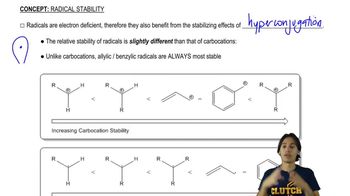
The radical stability trend.

Peroxide Formation Mechanism

Peroxide formation in ethers typically occurs through a radical chain mechanism initiated by the abstraction of a hydrogen atom, forming a radical that reacts with oxygen. This process is more favorable in ethers with less steric hindrance and more accessible hydrogen atoms, as these conditions facilitate the initial radical formation and subsequent reactions with oxygen.
Video consigliato:
02:26
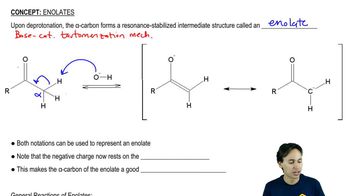
Formation of Enolates

Radical Stability

The stability of radicals formed during peroxide formation is crucial in determining the likelihood of peroxide formation. Radicals are stabilized by resonance and hyperconjugation, which can be influenced by the substituents on the ether. Ethers with substituents that stabilize radicals will more readily form peroxides, as the intermediate radicals are more stable and persistent.
Video consigliato:
03:43
The radical stability trend.