Ch. 12 - Substitution and Elimination: Reactions of Haloalkanes
Mullins - Organic Chemistry: A Learner Centered Approach 1st Edition
Mullins1st EditionOrganic Chemistry: A Learner Centered ApproachISBN: 9780137566471Non è quello che usi tu?Cambia libro di testo
Capitolo 11, Problema 57b

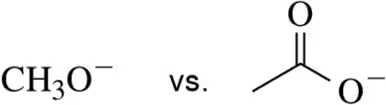
For each pair, choose the nucleophile that would react most quickly in an SN2 reaction (assume H2O is the solvent).
(b) Comparison of two nucleophiles: methoxide ion (CH3O−) on the left and alkoxide ion (O−) on the right.

Guida verificata passo dopo passo
1
Step 1: Understand the Sₙ2 reaction mechanism. Sₙ2 reactions are bimolecular nucleophilic substitution reactions where the nucleophile attacks the electrophilic carbon in a single step, leading to the displacement of the leaving group. The rate of the reaction depends on the strength of the nucleophile and steric hindrance around the electrophilic carbon.
Step 2: Evaluate the nucleophiles provided in the pair. In an Sₙ2 reaction, a stronger nucleophile will react more quickly. Nucleophilicity is influenced by factors such as charge, electronegativity, and the solvent. In this case, H₂O is the solvent, which is polar protic and can stabilize charged nucleophiles, reducing their reactivity.
Step 3: Compare the nucleophiles based on their structure and charge. A negatively charged nucleophile is generally stronger than a neutral one. Additionally, less electronegative atoms tend to be better nucleophiles because they hold their electrons less tightly and are more willing to donate them.
Step 4: Consider steric hindrance. In an Sₙ2 reaction, bulky nucleophiles are less effective because they face difficulty accessing the electrophilic carbon. Smaller, less hindered nucleophiles will react more quickly.
Step 5: Make a decision based on the above factors. Identify which nucleophile in the pair is stronger and less sterically hindered, and thus would react most quickly in the Sₙ2 reaction in the presence of H₂O as the solvent.

Risposta video verificata per un problema simile:

Questa soluzione video è stata consigliata dai nostri tutor come utile per risolvere questo problema.
Durata del video:
3m

Concetti chiave

Ecco i concetti essenziali che devi comprendere per rispondere correttamente alla domanda.

Nucleophilicity

Nucleophilicity refers to the ability of a species to donate an electron pair to an electrophile, forming a chemical bond. In Sₙ2 reactions, stronger nucleophiles react more quickly due to their greater electron density and ability to stabilize the transition state. Factors influencing nucleophilicity include charge, electronegativity, and solvent effects, with negatively charged species generally being more nucleophilic than their neutral counterparts.
Video consigliato:
08:27
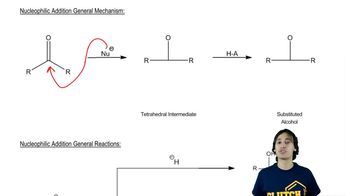
Nucleophilic Addition

Sₙ2 Mechanism

The Sₙ2 (substitution nucleophilic bimolecular) mechanism involves a single concerted step where the nucleophile attacks the electrophile while simultaneously displacing a leaving group. This reaction is characterized by a backside attack, leading to inversion of configuration at the chiral center. The rate of an Sₙ2 reaction depends on both the concentration of the nucleophile and the electrophile, making it bimolecular.
Video consigliato:
04:32
General Mechanism

Solvent Effects

The choice of solvent can significantly influence the rate of Sₙ2 reactions. Polar protic solvents, like water, can stabilize ions through solvation, which may hinder nucleophilicity by surrounding the nucleophile and making it less reactive. In contrast, polar aprotic solvents do not solvate anions as effectively, allowing nucleophiles to remain more reactive. Understanding solvent effects is crucial for predicting reaction outcomes in nucleophilic substitutions.
Video consigliato:
01:16
Identification of polarity in solvents