Ch. 12 - Substitution and Elimination: Reactions of Haloalkanes
Mullins - Organic Chemistry: A Learner Centered Approach 1st Edition
Mullins1st EditionOrganic Chemistry: A Learner Centered ApproachISBN: 9780137566471Non è quello che usi tu?Cambia libro di testo
Capitolo 11, Problema 44c

Paying close attention to the stereochemical outcome, predict the product of these elimination reactions.
(c)

Guida verificata passo dopo passo
1
Step 1: Identify the type of elimination reaction. The presence of NaOH and H2O suggests that this is likely an E2 elimination reaction, as NaOH is a strong base.
Step 2: Analyze the stereochemistry of the molecule. The bromine atom is attached to a carbon that is adjacent to a β-hydrogen. Note that the β-hydrogen must be anti-periplanar to the leaving group (Br) for the E2 mechanism to proceed.
Step 3: Determine the possible β-hydrogens. In this case, there are two β-hydrogens available on the adjacent carbons. Evaluate which β-hydrogen is anti-periplanar to the bromine atom.
Step 4: Predict the double bond formation. The elimination of HBr will result in the formation of a double bond between the α-carbon (where Br is attached) and the β-carbon (where the β-hydrogen is removed). Consider the Zaitsev rule, which states that the more substituted alkene is generally favored.
Step 5: Draw the product with the correct stereochemistry. Ensure that the stereochemical outcome reflects the anti-periplanar geometry required for the E2 mechanism. The final product will be an alkene with the appropriate stereochemistry based on the starting material.

Risposta video verificata per un problema simile:

Questa soluzione video è stata consigliata dai nostri tutor come utile per risolvere questo problema.
Durata del video:
5m

Concetti chiave

Ecco i concetti essenziali che devi comprendere per rispondere correttamente alla domanda.

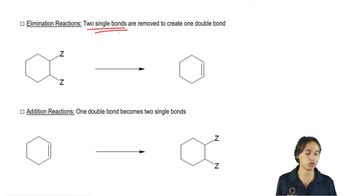
Elimination Reactions

Elimination reactions involve the removal of a small molecule from a larger one, typically resulting in the formation of a double bond. In organic chemistry, common elimination reactions include E1 and E2 mechanisms, which differ in their steps and conditions. Understanding the mechanism is crucial for predicting the stereochemical outcome of the reaction.
Video consigliato:
00:40
Recognizing Elimination Reactions.

Stereochemistry

Stereochemistry refers to the study of the spatial arrangement of atoms in molecules and how this affects their chemical behavior. In elimination reactions, the stereochemical outcome can lead to different products, such as cis or trans isomers, depending on the orientation of the leaving groups and the formation of the double bond. Recognizing stereochemical configurations is essential for accurate product prediction.
Video consigliato:
Percorso guidato
1:38
Polymer Stereochemistry Concept 1

Base Strength and Nucleophilicity

The strength of the base used in elimination reactions significantly influences the reaction pathway and product formation. Strong bases, like NaOH, favor E2 mechanisms, leading to the formation of alkenes. Understanding the role of the base helps in predicting whether the reaction will proceed via a concerted mechanism or through carbocation intermediates, impacting the stereochemical outcome.
Video consigliato:
04:53
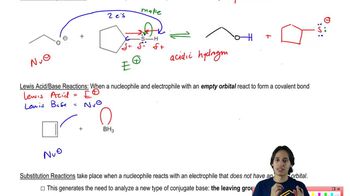
Nucleophiles and Electrophiles can react in Lewis Acid-Base Reactions.