Ch. 13 - Alcohols, Ethers and Related Compounds: Substitution and Elimination
Mullins - Organic Chemistry: A Learner Centered Approach 1st Edition
Mullins1st EditionOrganic Chemistry: A Learner Centered ApproachISBN: 9780137566471Non è quello che usi tu?Cambia libro di testo
Capitolo 12, Problema 62

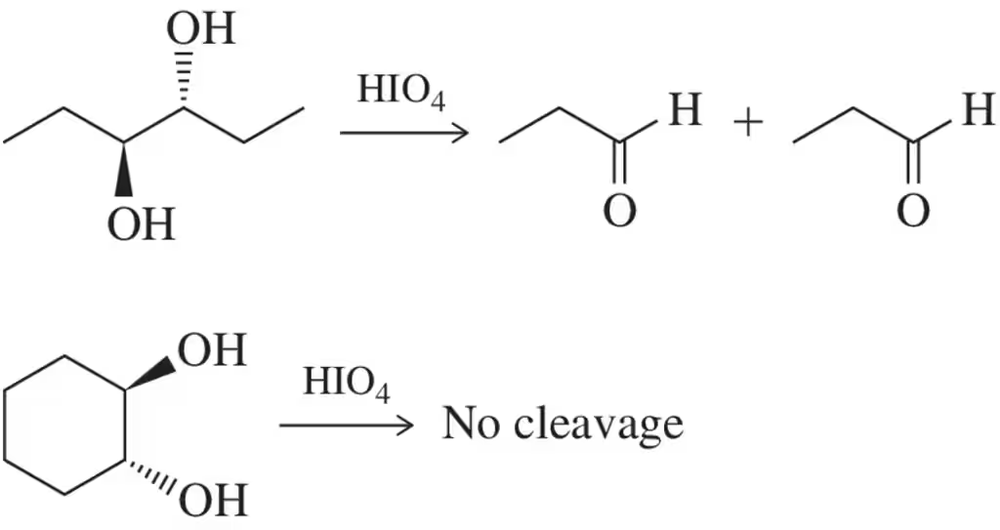
Although trans-diols in rings cannot be cleaved using HIO₄ acyclic trans-diols can. Explain this discrepancy.
Acyclic trans-diols cleaved by HIO₄ to aldehydes; cyclic trans-diols show no cleavage.

Guida verificata passo dopo passo
1
Understand the mechanism of periodic acid (HIO₄) cleavage: Periodic acid cleaves vicinal diols (1,2-diols) by oxidizing them to form aldehydes or ketones. This reaction involves the formation of a cyclic periodate ester intermediate.
Consider the structural requirements for the formation of the cyclic periodate ester: The diol must be able to form a five-membered cyclic intermediate with the periodate ion. This requires the hydroxyl groups to be in a cis configuration, or at least close enough in space to allow cyclization.
Analyze the structure of trans-diols in rings: In cyclic structures, trans-diols have hydroxyl groups on opposite sides of the ring, making it geometrically impossible to form the necessary cyclic intermediate with the periodate ion.
Compare with acyclic trans-diols: In acyclic systems, the flexibility of the carbon chain allows the trans-diols to rotate and adopt a conformation where the hydroxyl groups are close enough to form the cyclic periodate ester, enabling cleavage.
Conclude the discrepancy: The inability of cyclic trans-diols to form the cyclic intermediate due to geometric constraints prevents cleavage by HIO₄, whereas acyclic trans-diols can overcome these constraints through conformational flexibility.

Risposta video verificata per un problema simile:

Questa soluzione video è stata consigliata dai nostri tutor come utile per risolvere questo problema.
Durata del video:
4m

Concetti chiave

Ecco i concetti essenziali che devi comprendere per rispondere correttamente alla domanda.

Periodic Acid Cleavage

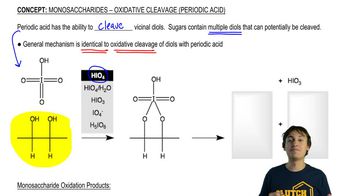
Periodic acid (HIO₄) is used to cleave vicinal diols, converting them into aldehydes or ketones. This reaction requires the diols to be in a specific orientation that allows the formation of a cyclic intermediate, which is crucial for the cleavage process. The ability to form this intermediate is influenced by the spatial arrangement of the diols.
Video consigliato:
06:41
Monosaccharides - Oxidative Cleavage

Cyclic vs. Acyclic Diols

Cyclic diols are part of a ring structure, which restricts their spatial orientation due to the rigidity of the ring. This rigidity can prevent the necessary alignment for periodic acid cleavage. In contrast, acyclic diols have more freedom in their spatial arrangement, allowing them to adopt the conformation needed for the reaction to proceed.
Video consigliato:
06:23
Monosaccharides - Forming Cyclic Hemiacetals

Stereochemistry of Diols

Stereochemistry refers to the spatial arrangement of atoms in molecules. For periodic acid cleavage, the stereochemistry of diols is crucial; trans-diols in rings often cannot achieve the required orientation due to steric hindrance and ring strain. Acyclic trans-diols, however, can rotate freely to align properly, facilitating the cleavage by periodic acid.
Video consigliato:
Percorso guidato
1:38
Polymer Stereochemistry Concept 1