Ch. 13 - Alcohols, Ethers and Related Compounds: Substitution and Elimination
Mullins - Organic Chemistry: A Learner Centered Approach 1st Edition
Mullins1st EditionOrganic Chemistry: A Learner Centered ApproachISBN: 9780137566471Non è quello che usi tu?Cambia libro di testo
Capitolo 12, Problema 51a

Identify the alcohols that would undergo oxidation to produce the following carbonyl compounds.
(a)

Guida verificata passo dopo passo
1
Examine the given carbonyl compound structure. The image shows a ketone with a carbonyl group (C=O) attached to a secondary carbon atom.
Identify the position of the carbonyl group in the structure. In this case, the carbonyl group is on the second carbon of a four-carbon chain, indicating a ketone.
Recall that secondary alcohols are oxidized to form ketones. Therefore, the alcohol precursor must have had a hydroxyl group (-OH) on the same carbon that now holds the carbonyl group.
Determine the structure of the alcohol. Replace the carbonyl group (C=O) with a hydroxyl group (-OH) on the same carbon to revert the ketone back to its corresponding alcohol.
The resulting alcohol structure is 2-butanol, which is a secondary alcohol. This alcohol, when oxidized, would produce the given ketone structure.

Risposta video verificata per un problema simile:

Questa soluzione video è stata consigliata dai nostri tutor come utile per risolvere questo problema.

Concetti chiave

Ecco i concetti essenziali che devi comprendere per rispondere correttamente alla domanda.

Alcohol Oxidation

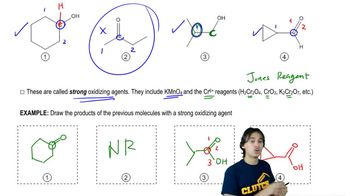
Alcohols can be oxidized to form carbonyl compounds, such as aldehydes and ketones. The oxidation process involves the removal of hydrogen atoms or the addition of oxygen, which transforms the hydroxyl (-OH) group of the alcohol into a carbonyl (C=O) group. The type of alcohol (primary, secondary, or tertiary) determines the product formed during oxidation.
Video consigliato:
05:53
Strong oxidizing agents

Types of Alcohols

There are three main types of alcohols: primary, secondary, and tertiary. Primary alcohols can be oxidized to aldehydes, while secondary alcohols can be oxidized to ketones. Tertiary alcohols, however, do not undergo oxidation to form carbonyl compounds due to the lack of a hydrogen atom on the carbon bearing the hydroxyl group.
Video consigliato:
01:01
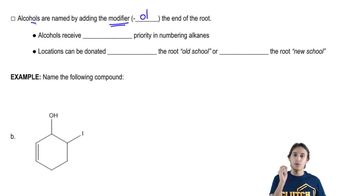
How to name alcohols

Oxidizing Agents

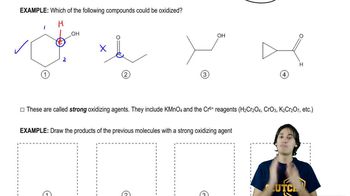
Oxidizing agents are substances that facilitate the oxidation of alcohols by accepting electrons. Common oxidizing agents include potassium dichromate (K2Cr2O7), chromium trioxide (CrO3), and sodium hypochlorite (NaOCl). The choice of oxidizing agent can influence the reaction conditions and the specific carbonyl compound produced from the alcohol.
Video consigliato:
03:40
Strong oxidizing agents