Ch. 13 - Alcohols, Ethers and Related Compounds: Substitution and Elimination
Mullins - Organic Chemistry: A Learner Centered Approach 1st Edition
Mullins1st EditionOrganic Chemistry: A Learner Centered ApproachISBN: 9780137566471Non è quello che usi tu?Cambia libro di testo
Capitolo 12, Problema 8

Label each hydroxyl group in Assessment 13.6 as primary (1°) secondary (2°) , or tertiary (3°) 

Guida verificata passo dopo passo
1
Identify the carbon atom to which each hydroxyl group (-OH) is attached. The classification of the hydroxyl group depends on the type of carbon it is bonded to.
Determine if the carbon atom attached to the hydroxyl group is bonded to one, two, or three other carbon atoms. This will help classify the hydroxyl group as primary (1°), secondary (2°), or tertiary (3°).
If the carbon atom attached to the hydroxyl group is bonded to only one other carbon atom, the hydroxyl group is classified as primary (1°).
If the carbon atom attached to the hydroxyl group is bonded to two other carbon atoms, the hydroxyl group is classified as secondary (2°).
If the carbon atom attached to the hydroxyl group is bonded to three other carbon atoms, the hydroxyl group is classified as tertiary (3°).

Risposta video verificata per un problema simile:

Questa soluzione video è stata consigliata dai nostri tutor come utile per risolvere questo problema.

Concetti chiave

Ecco i concetti essenziali che devi comprendere per rispondere correttamente alla domanda.

Hydroxyl Group Classification

Hydroxyl groups (-OH) can be classified based on the carbon atom to which they are attached. A primary (1°) hydroxyl group is attached to a carbon that is connected to only one other carbon, a secondary (2°) hydroxyl group is attached to a carbon connected to two other carbons, and a tertiary (3°) hydroxyl group is attached to a carbon connected to three other carbons.
Video consigliato:
07:17
Structural Classification

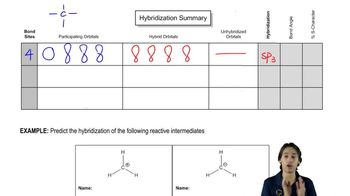
Carbon Hybridization

The hybridization of carbon atoms plays a crucial role in determining the structure and reactivity of organic compounds. In the context of hydroxyl groups, sp3 hybridized carbons are typically involved, influencing the geometry and bond angles around the hydroxyl group, which in turn affects the classification as primary, secondary, or tertiary.
Video consigliato:
10:43
Using bond sites to predict hybridization

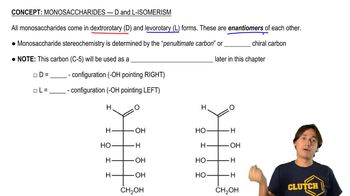
Structural Isomerism

Structural isomerism refers to compounds that have the same molecular formula but different structural arrangements. Understanding this concept is essential when labeling hydroxyl groups, as the position of the hydroxyl group on the carbon chain can lead to different isomers, each with distinct properties and classifications.
Video consigliato:
06:47
Monosaccharides - D and L Isomerism