Ch. 13 - Alcohols, Ethers and Related Compounds: Substitution and Elimination
Mullins - Organic Chemistry: A Learner Centered Approach 1st Edition
Mullins1st EditionOrganic Chemistry: A Learner Centered ApproachISBN: 9780137566471Non è quello che usi tu?Cambia libro di testo
Capitolo 12, Problema 100c

Predict the product and draw the mechanism for the acid-catalyzed pinacol rearrangement of the following diols.
(c)

Guida verificata passo dopo passo
1
Identify the diol structure: The given compound is a vicinal diol with two hydroxyl groups on adjacent carbon atoms. The structure also contains a pyridine ring, which is a heterocyclic aromatic compound.
Protonation of the hydroxyl group: In an acid-catalyzed reaction, one of the hydroxyl groups will be protonated by the acid, making it a better leaving group. This step forms a water molecule that can leave, generating a carbocation.
Formation of the carbocation: The departure of the water molecule from the protonated hydroxyl group results in the formation of a carbocation. The stability of this carbocation is crucial for the rearrangement process.
Rearrangement via 1,2-shift: A 1,2-methyl shift occurs to stabilize the carbocation. This involves the migration of a methyl group from the adjacent carbon to the carbocation center, resulting in a more stable carbocation.
Deprotonation to form the ketone: Finally, the carbocation is deprotonated to form a carbonyl group, resulting in the formation of a ketone. This completes the pinacol rearrangement, converting the diol into a ketone.

Risposta video verificata per un problema simile:

Questa soluzione video è stata consigliata dai nostri tutor come utile per risolvere questo problema.

Concetti chiave

Ecco i concetti essenziali che devi comprendere per rispondere correttamente alla domanda.

Pinacol Rearrangement

The pinacol rearrangement is a chemical reaction involving the conversion of a pinacol (a 1,2-diol) into a ketone or aldehyde under acidic conditions. This process involves the migration of an alkyl group and the formation of a carbocation intermediate, which is then stabilized by rearrangement. Understanding this mechanism is crucial for predicting the products formed from specific diols.
Video consigliato:
06:08
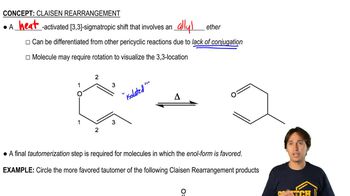
Definition of Claisen Rearrangement

Carbocation Stability

Carbocations are positively charged carbon species that play a key role in many organic reactions, including the pinacol rearrangement. The stability of a carbocation is influenced by factors such as the degree of substitution (primary, secondary, tertiary) and resonance effects. Recognizing the most stable carbocation formed during the rearrangement helps in predicting the final product of the reaction.
Video consigliato:
05:58
Determining Carbocation Stability

Acid-Catalyzed Mechanisms

Acid-catalyzed mechanisms involve the use of an acid to facilitate the reaction process, often by protonating functional groups to enhance their reactivity. In the context of the pinacol rearrangement, the acid activates the diol, leading to the formation of a more reactive carbocation. Understanding how acids influence reaction pathways is essential for accurately drawing the mechanism and predicting the products.
Video consigliato:
06:34
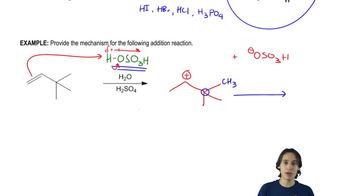
Acid-catalyzed hydration mechanism