

Ch. 13 - Alcohols, Ethers and Related Compounds: Substitution and Elimination
Mullins - Organic Chemistry: A Learner Centered Approach 1st Edition
Mullins1st EditionOrganic Chemistry: A Learner Centered ApproachISBN: 9780137566471Non è quello che usi tu?Cambia libro di testo
Capitolo 12, Problema 80b

Predict the product of the following epoxide addition reactions.
(b)

Guida verificata passo dopo passo
1
Identify the structure of the epoxide and the reagents involved in the reaction. Epoxides are three-membered cyclic ethers, and their reactions often involve nucleophilic attack.
Determine the type of reaction mechanism. Epoxide ring-opening reactions can proceed via either acid-catalyzed or base-catalyzed mechanisms, depending on the conditions provided.
For an acid-catalyzed mechanism, the epoxide oxygen is protonated, making the epoxide more electrophilic. The nucleophile then attacks the more substituted carbon due to the partial positive charge developed there.
For a base-catalyzed mechanism, the nucleophile directly attacks the less hindered carbon of the epoxide, leading to ring opening. This is because the nucleophile is strong and the reaction is under kinetic control.
Draw the structure of the product, ensuring that the stereochemistry is correctly represented. Consider any stereochemical implications of the reaction, such as inversion of configuration at the carbon where the nucleophile attacks.

Risposta video verificata per un problema simile:

Questa soluzione video è stata consigliata dai nostri tutor come utile per risolvere questo problema.
Durata del video:
3m

Concetti chiave

Ecco i concetti essenziali che devi comprendere per rispondere correttamente alla domanda.

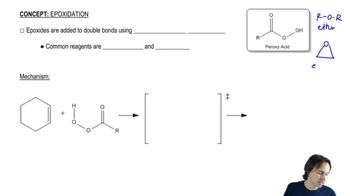
Epoxide Structure

Epoxides are three-membered cyclic ethers characterized by a highly strained ring structure. This strain makes them reactive intermediates in organic reactions, particularly in nucleophilic addition reactions. Understanding the geometry and reactivity of epoxides is crucial for predicting the products of their reactions.
Video consigliato:
02:19
General properties of epoxidation.

Nucleophilic Addition

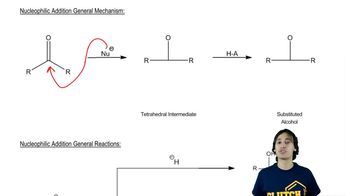
Nucleophilic addition is a fundamental reaction mechanism in organic chemistry where a nucleophile attacks an electrophilic center, leading to the formation of new bonds. In the case of epoxides, nucleophiles can open the strained ring, resulting in the formation of alcohols or other functional groups. The nature of the nucleophile and the reaction conditions can significantly influence the outcome.
Video consigliato:
08:27
Nucleophilic Addition

Stereochemistry of Reactions

Stereochemistry refers to the spatial arrangement of atoms in molecules and how this affects their chemical behavior. In epoxide addition reactions, the stereochemistry of the reactants and the nucleophile's approach can lead to different stereochemical outcomes in the products. Understanding stereochemical principles is essential for predicting the configuration of the final products.
Video consigliato:
Percorso guidato
1:38
Polymer Stereochemistry Concept 1