Unfortunately, the use of NMO creates an additional green chemistry problem. What is the problem and how might it be solved?
Ch. 13 - Alcohols, Ethers and Related Compounds: Substitution and Elimination

Mullins1st EditionOrganic Chemistry: A Learner Centered ApproachISBN: 9780137566471Non è quello che usi tu?Cambia libro di testo
Tutti i libri di testo
Mullins 1st Edition
Ch. 13 - Alcohols, Ethers and Related Compounds: Substitution and Elimination
Problema 66a
Mullins 1st Edition
Ch. 13 - Alcohols, Ethers and Related Compounds: Substitution and Elimination
Problema 66aCapitolo 12, Problema 66a
Predict the product of the following reactions. [Two of them are Williamson ether syntheses. Why isn't the other?].
(a) 
Guida verificata passo dopo passo1
Identify the starting materials: The reaction involves benzyl alcohol and bromobenzene.
Recognize the role of sodium (Na^0): Sodium metal is used to deprotonate the alcohol, forming a phenoxide ion.
Understand the Williamson ether synthesis: This reaction involves the formation of an ether by reacting an alkoxide ion with a primary alkyl halide.
Analyze the reaction conditions: The phenoxide ion will act as a nucleophile and attack the electrophilic carbon in the bromobenzene, leading to the formation of an ether.
Consider why this is a Williamson ether synthesis: The reaction involves the formation of an ether from an alkoxide ion and an alkyl halide, which is characteristic of Williamson ether synthesis.

Risposta video verificata per un problema simile:
Questa soluzione video è stata consigliata dai nostri tutor come utile per risolvere questo problema.
Concetti chiave
Ecco i concetti essenziali che devi comprendere per rispondere correttamente alla domanda.
Williamson Ether Synthesis
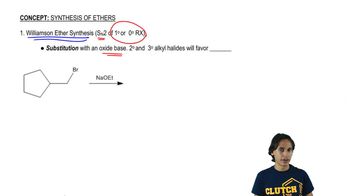
Williamson ether synthesis is a method for creating ethers through the reaction of an alkoxide ion with a primary alkyl halide. This reaction typically involves an SN2 mechanism, where the nucleophile (alkoxide) attacks the electrophilic carbon of the alkyl halide, resulting in the formation of an ether. The reaction is favored with primary halides to avoid steric hindrance and elimination reactions.
Video consigliato:
The Mechanism of Williamson Ether Synthesis.
SN2 Mechanism
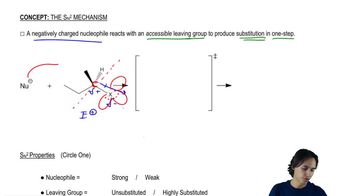
The SN2 mechanism is a type of nucleophilic substitution reaction characterized by a single concerted step where the nucleophile attacks the electrophile, leading to the displacement of a leaving group. This bimolecular reaction results in the inversion of configuration at the carbon center. It is most effective with primary substrates due to less steric hindrance, making it crucial for understanding Williamson ether synthesis.
Video consigliato:
Drawing the SN2 Mechanism
Reactivity of Alkyl Halides
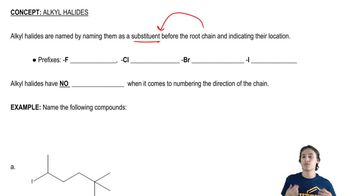
The reactivity of alkyl halides in nucleophilic substitution reactions depends on their structure. Primary alkyl halides are more reactive in SN2 reactions due to less steric hindrance, while tertiary halides favor elimination reactions (E2) due to steric crowding. Understanding the type of alkyl halide involved is essential for predicting the outcome of reactions, including why some reactions may not follow the Williamson ether synthesis pathway.
Video consigliato:
How to name alkyl halides
Pratica correlata
Domanda del libro di testo
934
views
Domanda del libro di testo
Ethers can be converted into radicals, some more easily than others. Which of the following radicals is more stable, and thus, more likely to form?
911
views
Domanda del libro di testo
Two different Williamson ether syntheses can be used to make the compound in (a). Show them. The compound in (b), however, can only be made one way. Show it and explain why a second Williamson ether synthesis is not possible.
(a)
992
views
Domanda del libro di testo
Propose a synthesis of the carbonyl(s) using the (ii) dihydroxylation/periodic acid cleavage pathways.
(b)
1159
views
Domanda del libro di testo
Predict the product of the following reactions. [Two of them are Williamson ether syntheses. Why isn't the other?].
(b)
683
views
Domanda del libro di testo
Predict the product of the following reactions. [Two of them are Williamson ether syntheses. Why isn't the other?].
(c)
763
views