Ch. 13 - Alcohols, Ethers and Related Compounds: Substitution and Elimination
Mullins - Organic Chemistry: A Learner Centered Approach 1st Edition
Mullins1st EditionOrganic Chemistry: A Learner Centered ApproachISBN: 9780137566471Non è quello che usi tu?Cambia libro di testo
Capitolo 12, Problema 106o(xi,xii)

Predict the product(s) that would result when molecules (a)–(p) are allowed to react under the following conditions: (xi) HOCl, H₂O (xii) HIO₄ If no reaction occurs, write 'no reaction.'
(o) Chemical structure of a phenol with a hydroxyl group attached to a carbon chain.

Guida verificata passo dopo passo
1
Identify the functional groups present in the molecule. The given molecule is a secondary alcohol attached to a benzene ring.
Consider the reaction conditions (xi) HOCl, H₂O. This is a hypochlorous acid in water, which can oxidize alcohols to chlorohydrins.
Predict the product for reaction (xi). The secondary alcohol will react with HOCl to form a chlorohydrin, where the hydroxyl group is replaced by a chlorine atom.
Consider the reaction conditions (xii) HIO₄. Periodic acid (HIO₄) is known to cleave vicinal diols (1,2-diols) into aldehydes or ketones.
Predict the product for reaction (xii). Since the molecule does not contain a vicinal diol, no reaction will occur with HIO₄.

Risposta video verificata per un problema simile:

Questa soluzione video è stata consigliata dai nostri tutor come utile per risolvere questo problema.

Concetti chiave

Ecco i concetti essenziali che devi comprendere per rispondere correttamente alla domanda.

Electrophilic Addition of HOCl

In the presence of HOCl and water, an electrophilic addition reaction can occur where the hydroxyl group (OH) and chlorine (Cl) add across a double bond. This reaction typically involves the formation of a chlorohydrin, where the OH group attaches to the more substituted carbon, and Cl attaches to the less substituted carbon, following Markovnikov's rule.
Video consigliato:
09:23
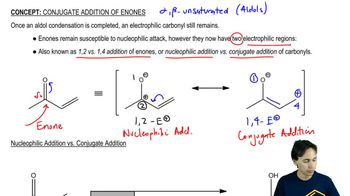
1,2 vs 1,4 Addition

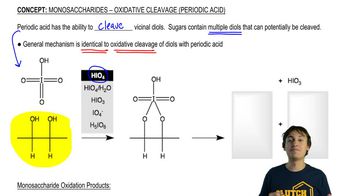
Oxidative Cleavage with Periodic Acid (HIO₄)

HIO₄ is used to cleave vicinal diols (1,2-diols) into aldehydes or ketones. The reaction involves the formation of a cyclic periodate intermediate, which breaks down to yield carbonyl compounds. This reaction is specific to diols that are adjacent, and if no such diol is present, no reaction occurs.
Video consigliato:
06:41
Monosaccharides - Oxidative Cleavage

Structure and Reactivity of Phenols

Phenols are aromatic compounds with a hydroxyl group directly attached to the benzene ring. The presence of the hydroxyl group increases the electron density of the ring, making it more reactive towards electrophilic substitution. However, the specific structure in the image shows a secondary alcohol attached to a phenyl group, which may not directly undergo reactions typical for phenols.
Video consigliato:
02:27
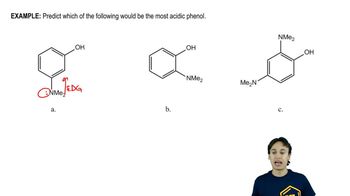
Identify the most acidic phenol
Pratica correlata
Domanda del libro di testo

Predict the product(s) that would result when molecules (a)–(p) are allowed to react under the following conditions: (v) 1. TsCl, Et₃N 2. NaOt-Bu (vi) H₂SO₄ If no reaction occurs, write 'no reaction.'

(o)

742
views

Domanda del libro di testo

Predict the product(s) that would result when molecules (a)–(p) are allowed to react under the following conditions: (ix) PCC; (x) H₂CrO₄ , H₂O. If no reaction occurs, write 'no reaction.'

(o)

782
views
Domanda del libro di testo

Cleavage of the following ether produces the alcohol and haloalkane only, regardless of how much HBr is used. Thinking about the mechanism of the reaction, explain why bromobenzene is not also a product of this reaction.

850
views
Domanda del libro di testo

Predict the product(s) that would result when molecules (a)–(p) are allowed to react under the following conditions: (iii) SOCl₂ , NEt₃ (iv) 1. TsCl, Et₃N 2. NaCN; If no reaction occurs, write 'no reaction.'

(o)

744
views
Domanda del libro di testo

Predict the product(s) that would result when molecules (a)–(p) are allowed to react under the following conditions: (i) SOCl₂ ; (ii) PBr₃ ; (iii) SOCl₂ , NEt₃ (iv) 1. TsCl, Et₃N 2. NaCN; (v) 1. TsCl, Et₃N 2. NaOt-Bu (vi) H₂SO₄ (vii) HCl; (viii) HBr; (ix) PCC; (x) H₂CrO₄ , H₂O (xi) HOCl, H₂O (xii) HIO₄ If no reaction occurs, write 'no reaction.'

(o)

613
views
Domanda del libro di testo

Predict the product(s) that would result when molecules (a)–(p) are allowed to react under the following conditions: (vii) HCl; (viii) HBr; If no reaction occurs, write 'no reaction.'

(o)

653
views