When HCl was used for the attempted dehydration reaction shown, a reaction occurred, but none of the desired product was formed. Suggest the identity of the actual product obtained.
Ch. 13 - Alcohols, Ethers and Related Compounds: Substitution and Elimination

Mullins1st EditionOrganic Chemistry: A Learner Centered ApproachISBN: 9780137566471Non è quello che usi tu?Cambia libro di testo
Tutti i libri di testo
Mullins 1st Edition
Ch. 13 - Alcohols, Ethers and Related Compounds: Substitution and Elimination
Problema 35b
Mullins 1st Edition
Ch. 13 - Alcohols, Ethers and Related Compounds: Substitution and Elimination
Problema 35bCapitolo 12, Problema 35b
Provide the alcohol that would be used to make the bromoalkanes shown using PBr₃.
(b) 
Guida verificata passo dopo passo1
Understand the reaction mechanism: The conversion of alcohols to bromoalkanes using phosphorus tribromide (PBr₃) is a substitution reaction where the hydroxyl group (-OH) of the alcohol is replaced by a bromine atom.
Identify the structure of the bromoalkane: Analyze the given bromoalkane structure to determine the carbon chain and the position of the bromine atom.
Determine the corresponding alcohol: To find the alcohol precursor, replace the bromine atom in the bromoalkane with a hydroxyl group (-OH) at the same position.
Consider stereochemistry: If the bromoalkane has chiral centers, ensure that the stereochemistry is considered, as PBr₃ can lead to inversion of configuration at the chiral center.
Verify the alcohol structure: Double-check the structure of the alcohol to ensure it matches the requirements for the reaction with PBr₃, such as primary or secondary alcohols being suitable for this conversion.

Risposta video verificata per un problema simile:
Questa soluzione video è stata consigliata dai nostri tutor come utile per risolvere questo problema.
Durata del video:
1mConcetti chiave
Ecco i concetti essenziali che devi comprendere per rispondere correttamente alla domanda.
Alcohols
Alcohols are organic compounds characterized by the presence of a hydroxyl group (-OH) attached to a carbon atom. They serve as precursors in various chemical reactions, including the formation of bromoalkanes. Understanding the structure and reactivity of alcohols is crucial for predicting the outcome of reactions involving PBr₃.
Video consigliato:
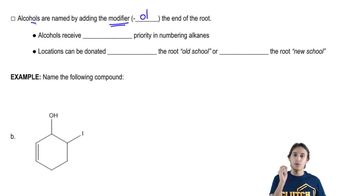
How to name alcohols
Bromoalkanes
Bromoalkanes, or alkyl bromides, are organic compounds where a bromine atom is bonded to an alkyl group. They are typically synthesized from alcohols through substitution reactions using reagents like PBr₃. Recognizing the structure of bromoalkanes helps in identifying the corresponding alcohol needed for their synthesis.
PBr₃ Reaction Mechanism
Phosphorus tribromide (PBr₃) is used to convert alcohols into bromoalkanes via a substitution reaction. The mechanism involves the formation of an intermediate where the hydroxyl group is replaced by a bromine atom. Understanding this mechanism is essential for determining which alcohol will yield a specific bromoalkane.
Video consigliato:
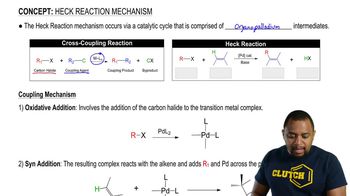
Heck Reaction Mechanism
Pratica correlata
Domanda del libro di testo
1193
views
Domanda del libro di testo
Provide the alcohol that would be used to make the bromoalkanes shown using PBr₃.
(c)
789
views
Domanda del libro di testo
Provide the alcohol that would be used to make the bromoalkanes shown using PBr₃.
(a)
976
views
Domanda del libro di testo
Besides PBr3. and SOCl2 , there are other ways of synthesizing haloalkanes. One such way is shown. Provide an arrow-pushing mechanism that rationalizes formation of the chloroalkane. [Hint: Dimethyl sulfide is a good nucleophile and Cl₂ is an electrophile. Start by reacting those two together.]
408
views
Domanda del libro di testo
Identify the reagent that should be used to obtain each stereochemical outcome shown.
(b)
852
views
Domanda del libro di testo
Identify the reagent that should be used to obtain each stereochemical outcome shown.
(a)
820
views