Ch. 14 - Structural Identification 1: Infrared Spectroscopy and Mass Spectrometry
Mullins - Organic Chemistry: A Learner Centered Approach 1st Edition
Mullins1st EditionOrganic Chemistry: A Learner Centered ApproachISBN: 9780137566471Non è quello che usi tu?Cambia libro di testo
Capitolo 13, Problema 44

2-Methylnonan-4-one can undergo two different McLafferty rearrangements. Draw the products of each of them.
Chemical structure of 2-methylnonan-4-one, showing a ketone group on a nine-carbon chain with a methyl branch.

Guida verificata passo dopo passo
1
Identify the structure of 2-Methylnonan-4-one. It is a ketone with a methyl group on the second carbon and a ketone group on the fourth carbon of a nonane chain.
Understand the McLafferty rearrangement: It involves a six-membered cyclic transition state where a hydrogen atom three carbons away from the carbonyl group is transferred to the oxygen, resulting in a double bond and cleavage of the molecule.
Locate the possible gamma (γ) hydrogens relative to the carbonyl group in 2-Methylnonan-4-one. These are the hydrogens on the third and fifth carbons from the carbonyl carbon.
For the first McLafferty rearrangement, consider the γ-hydrogen on the third carbon. This will lead to a cleavage between the third and fourth carbons, forming a product with a double bond between the second and third carbons and a separate fragment containing the carbonyl group.
For the second McLafferty rearrangement, consider the γ-hydrogen on the fifth carbon. This will lead to a cleavage between the fifth and sixth carbons, forming a product with a double bond between the fourth and fifth carbons and a separate fragment containing the carbonyl group.

Risposta video verificata per un problema simile:

Questa soluzione video è stata consigliata dai nostri tutor come utile per risolvere questo problema.

Concetti chiave

Ecco i concetti essenziali che devi comprendere per rispondere correttamente alla domanda.

McLafferty Rearrangement

The McLafferty rearrangement is a mass spectrometry fragmentation process where a molecule undergoes a specific rearrangement involving a six-membered transition state. Typically, it involves the transfer of a hydrogen atom from a gamma position relative to a carbonyl group, resulting in the cleavage of a bond and formation of an enol and an alkene. Understanding this mechanism is crucial for predicting the fragmentation pattern of carbonyl-containing compounds.
Video consigliato:
06:08
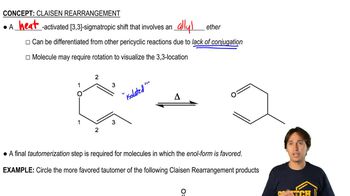
Definition of Claisen Rearrangement

Carbonyl Group

A carbonyl group consists of a carbon atom double-bonded to an oxygen atom (C=O). It is a key functional group in organic chemistry, found in aldehydes, ketones, carboxylic acids, and their derivatives. The carbonyl group is highly polar, making it reactive and a common site for chemical reactions, such as nucleophilic additions and rearrangements like the McLafferty rearrangement.
Video consigliato:
03:50
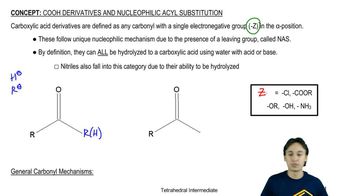
Intro to Carboxylic Acid Derivatives

Gamma Hydrogen

In organic chemistry, a gamma hydrogen refers to a hydrogen atom located on the third carbon atom away from a functional group, such as a carbonyl group. In the context of the McLafferty rearrangement, the presence of a gamma hydrogen is essential as it participates in the hydrogen transfer that initiates the rearrangement process, leading to the formation of specific fragmentation products.
Video consigliato:
00:48
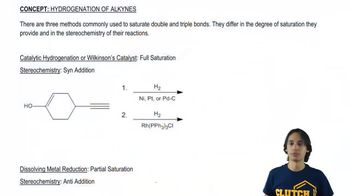
The definition of hydrogenation.