Ch. 14 - Structural Identification 1: Infrared Spectroscopy and Mass Spectrometry
Mullins - Organic Chemistry: A Learner Centered Approach 1st Edition
Mullins1st EditionOrganic Chemistry: A Learner Centered ApproachISBN: 9780137566471Non è quello che usi tu?Cambia libro di testo
Capitolo 13, Problema 47b

Choose the bond in each pair that you expect to have the more intense stretching band
(b) C=O vs. C=N

Guida verificata passo dopo passo
1
Identify the type of bonds in question: C=O (carbon-oxygen double bond) and C=N (carbon-nitrogen double bond).
Understand that the intensity of an IR stretching band is influenced by the dipole moment change during the vibration. A greater change in dipole moment results in a more intense band.
Consider the electronegativity of the atoms involved: Oxygen is more electronegative than nitrogen, which means the C=O bond will have a greater dipole moment compared to the C=N bond.
Recognize that the greater the difference in electronegativity between the bonded atoms, the more polar the bond, and thus, the more intense the IR absorption band.
Conclude that the C=O bond is expected to have a more intense stretching band than the C=N bond due to the higher dipole moment change during vibration.

Risposta video verificata per un problema simile:

Questa soluzione video è stata consigliata dai nostri tutor come utile per risolvere questo problema.

Concetti chiave

Ecco i concetti essenziali che devi comprendere per rispondere correttamente alla domanda.

Infrared Spectroscopy

Infrared (IR) spectroscopy is a technique used to identify functional groups in organic molecules by measuring the absorption of infrared light, which causes molecular vibrations. The intensity of the absorption band in an IR spectrum is related to the change in dipole moment during the vibration. A greater change in dipole moment results in a more intense absorption band.
Video consigliato:
Percorso guidato
2:56
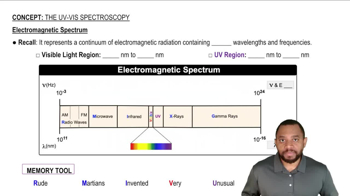
The UV-Vis Spectroscopy Concept 1

Dipole Moment

The dipole moment is a measure of the separation of positive and negative charges in a molecule. It is a vector quantity, with both magnitude and direction, and is crucial in determining the intensity of IR absorption bands. Bonds with larger dipole moments typically exhibit more intense stretching bands in IR spectroscopy due to greater changes in dipole moment during vibration.
Video consigliato:
01:46
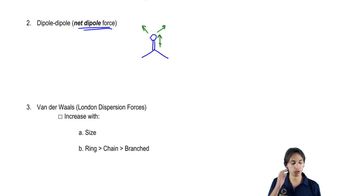
How dipole-dipole forces work.

Bond Polarity and Electronegativity

Bond polarity arises from differences in electronegativity between two bonded atoms, leading to an uneven distribution of electron density. In the context of IR spectroscopy, more polar bonds, such as C=O, tend to have more intense stretching bands compared to less polar bonds like C=N, due to the larger change in dipole moment during vibration.
Video consigliato:
1:47
Electronegativity