Ch. 14 - Structural Identification 1: Infrared Spectroscopy and Mass Spectrometry
Mullins - Organic Chemistry: A Learner Centered Approach 1st Edition
Mullins1st EditionOrganic Chemistry: A Learner Centered ApproachISBN: 9780137566471Non è quello che usi tu?Cambia libro di testo
Capitolo 13, Problema 1b

Given the molecular formula, calculate the index of hydrogen deficiency.
(b) C4H9ON

Guida verificata passo dopo passo
1
Step 1: Understand the concept of the Index of Hydrogen Deficiency (IHD). The IHD, also known as the degree of unsaturation, indicates the number of rings, double bonds, or triple bonds in a molecule. Each degree of unsaturation corresponds to the loss of two hydrogens compared to a fully saturated molecule.
Step 2: Use the formula for IHD: IHD = (2C + 2 + N - H - X) / 2, where C is the number of carbons, H is the number of hydrogens, N is the number of nitrogens, and X is the number of halogens (if present). Oxygen (O) does not affect the IHD calculation.
Step 3: Substitute the values from the molecular formula C₄H₉ON into the IHD formula. Here, C = 4, H = 9, N = 1, and there are no halogens (X = 0). Oxygen is ignored in the calculation.
Step 4: Perform the calculation step-by-step. First, calculate the numerator: (2 × 4) + 2 + 1 - 9 - 0. Then divide the result by 2 to determine the IHD.
Step 5: Interpret the result. If the IHD is 0, the molecule is fully saturated (no rings or double/triple bonds). If the IHD is 1 or higher, it indicates the presence of unsaturation (e.g., a ring or a double bond).

Risposta video verificata per un problema simile:

Questa soluzione video è stata consigliata dai nostri tutor come utile per risolvere questo problema.

Concetti chiave

Ecco i concetti essenziali che devi comprendere per rispondere correttamente alla domanda.

Index of Hydrogen Deficiency (IHD)

The Index of Hydrogen Deficiency (IHD) is a measure of the degree of unsaturation in a molecular formula. It indicates the number of rings and/or multiple bonds present in a compound. Each double bond or ring contributes one to the IHD, while each triple bond contributes two. The formula for calculating IHD is IHD = (2C + 2 + N - H - X) / 2, where C is the number of carbons, N is the number of nitrogens, H is the number of hydrogens, and X is the number of halogens.
Video consigliato:
01:15
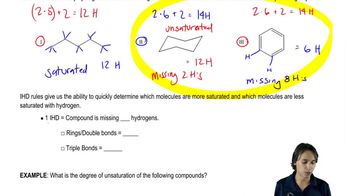
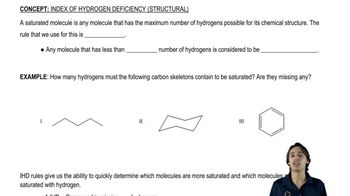
What index of hydrogen deficiency is.

Molecular Formula Interpretation

A molecular formula provides the number and types of atoms in a molecule, but does not indicate the structure. In the case of C₄H₉ON, the formula indicates four carbon atoms, nine hydrogen atoms, one oxygen atom, and one nitrogen atom. Understanding how to interpret this formula is crucial for calculating the IHD, as it allows for the identification of the elements involved and their contributions to the overall saturation of the molecule.
Video consigliato:
06:06
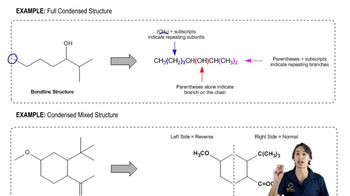
How to interpret condensed structures.

Unsaturation in Organic Compounds

Unsaturation refers to the presence of double or triple bonds in organic compounds, which affects their reactivity and physical properties. Compounds with higher unsaturation typically have lower hydrogen counts relative to their carbon counts. Recognizing the implications of unsaturation is essential for predicting the behavior of organic molecules, including their stability and potential reactions, which is directly related to the calculation of the IHD.
Video consigliato:
02:39
The difference between saturated and unsaturated molecules.