Ch. 14 - Structural Identification 1: Infrared Spectroscopy and Mass Spectrometry
Mullins - Organic Chemistry: A Learner Centered Approach 1st Edition
Mullins1st EditionOrganic Chemistry: A Learner Centered ApproachISBN: 9780137566471Non è quello che usi tu?Cambia libro di testo
Capitolo 13, Problema 6b

Identify the more stable carbocation in each pair.
(b) Two structural formulas of carbocations with plus signs, comparing their stability.

Guida verificata passo dopo passo
1
Step 1: Analyze the structure of each carbocation. The first carbocation is a tertiary carbocation (the positively charged carbon is attached to three other carbon atoms), while the second carbocation is a secondary carbocation (the positively charged carbon is attached to two other carbon atoms).
Step 2: Recall the concept of carbocation stability. Carbocations are stabilized by the inductive effect and hyperconjugation. Tertiary carbocations are more stable than secondary carbocations because they have more alkyl groups donating electron density to the positively charged carbon.
Step 3: Consider hyperconjugation. The tertiary carbocation has more adjacent C-H bonds that can participate in hyperconjugation, further stabilizing the positive charge.
Step 4: Evaluate the inductive effect. The tertiary carbocation benefits from the electron-donating effects of three alkyl groups, whereas the secondary carbocation only has two alkyl groups contributing to stabilization.
Step 5: Conclude that the tertiary carbocation is more stable than the secondary carbocation based on the combined effects of hyperconjugation and the inductive effect.

Risposta video verificata per un problema simile:

Questa soluzione video è stata consigliata dai nostri tutor come utile per risolvere questo problema.

Concetti chiave

Ecco i concetti essenziali che devi comprendere per rispondere correttamente alla domanda.

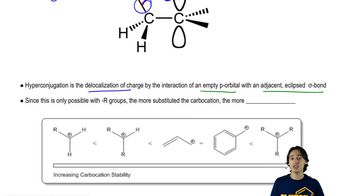
Carbocation Stability

Carbocations are positively charged carbon species that can vary in stability based on their structure. Stability increases with the degree of substitution; tertiary carbocations (three alkyl groups attached) are more stable than secondary (two alkyl groups) and primary (one alkyl group) due to hyperconjugation and inductive effects from surrounding alkyl groups.
Video consigliato:
05:58
Determining Carbocation Stability

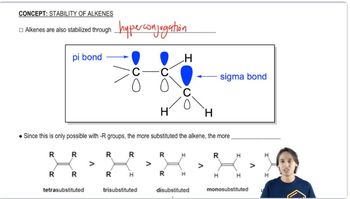
Hyperconjugation

Hyperconjugation is the stabilizing interaction that occurs when the electrons in a sigma bond (usually C-H or C-C) interact with an adjacent empty p-orbital of a carbocation. This delocalization of electrons helps to spread out the positive charge, thereby increasing the stability of the carbocation.
Video consigliato:
04:28
Understanding trends of alkene stability.

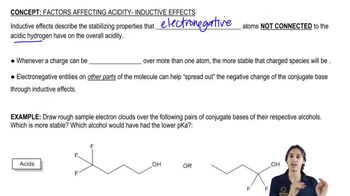
Inductive Effect

The inductive effect refers to the electron-withdrawing or electron-donating effects of substituents attached to a carbon chain. Alkyl groups are electron-donating, which can help stabilize a carbocation by dispersing the positive charge through the sigma bonds, making carbocations with more alkyl groups attached more stable.
Video consigliato:
01:47
Understanding the Inductive Effect.