Ch. 14 - Structural Identification 1: Infrared Spectroscopy and Mass Spectrometry
Mullins - Organic Chemistry: A Learner Centered Approach 1st Edition
Mullins1st EditionOrganic Chemistry: A Learner Centered ApproachISBN: 9780137566471Non è quello che usi tu?Cambia libro di testo
Capitolo 13, Problema 37

In the mass spectrum of hexan-3-ol, identify the fragments arising from two α-cleavage fragmentations and one dehydration fragmentation.
<IMAGE>

Guida verificata passo dopo passo
1
Identify the structure of hexan-3-ol: It is a six-carbon chain alcohol with the hydroxyl group (-OH) on the third carbon. The molecular formula is C6H14O.
Understand α-cleavage: In mass spectrometry, α-cleavage involves breaking the bond adjacent to the carbon bearing the functional group. For hexan-3-ol, this means breaking the C-C bonds adjacent to the carbon with the -OH group.
Perform the first α-cleavage: Break the bond between the second and third carbon atoms. This results in a fragment with a positive charge on the second carbon, forming a C2H5+ ion and a neutral fragment.
Perform the second α-cleavage: Break the bond between the third and fourth carbon atoms. This results in a fragment with a positive charge on the third carbon, forming a C3H7+ ion and a neutral fragment.
Consider dehydration fragmentation: Dehydration involves the loss of a water molecule (H2O) from the alcohol. In hexan-3-ol, this typically occurs by removing the hydroxyl group and a hydrogen from an adjacent carbon, resulting in the formation of an alkene fragment with a double bond.

Risposta video verificata per un problema simile:

Questa soluzione video è stata consigliata dai nostri tutor come utile per risolvere questo problema.

Concetti chiave

Ecco i concetti essenziali che devi comprendere per rispondere correttamente alla domanda.

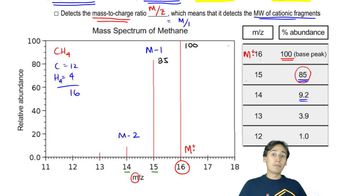
Mass Spectrometry

Mass spectrometry is an analytical technique used to measure the mass-to-charge ratio of ions. It helps identify the composition of a sample by generating a mass spectrum, which displays the masses of fragments. Understanding how molecules break apart in a mass spectrometer is crucial for interpreting the spectrum and identifying molecular fragments.
Video consigliato:
01:25
How to Read a Mass Spectrum

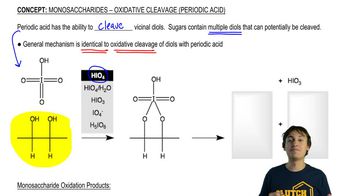
α-Cleavage

α-Cleavage in mass spectrometry involves the breaking of a bond adjacent to a functional group, such as an alcohol group in hexan-3-ol. This process results in the formation of a radical and a cation. Identifying the specific bonds that undergo α-cleavage helps determine the resulting fragments in the mass spectrum.
Video consigliato:
06:41
Monosaccharides - Oxidative Cleavage

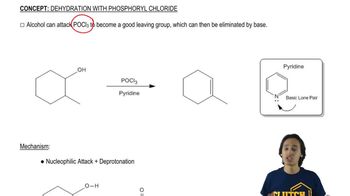
Dehydration Fragmentation

Dehydration fragmentation is a common reaction in mass spectrometry for alcohols, where a water molecule (H2O) is eliminated. This process typically results in the formation of an alkene. Recognizing dehydration is essential for identifying the characteristic mass loss of 18 amu, corresponding to the removal of water, in the mass spectrum.
Video consigliato:
01:23
General Reaction of Dehydration with POCl3