
Ch. 14 - Structural Identification 1: Infrared Spectroscopy and Mass Spectrometry
Mullins - Organic Chemistry: A Learner Centered Approach 1st Edition
Mullins1st EditionOrganic Chemistry: A Learner Centered ApproachISBN: 9780137566471Non è quello che usi tu?Cambia libro di testo
Capitolo 13, Problema 55

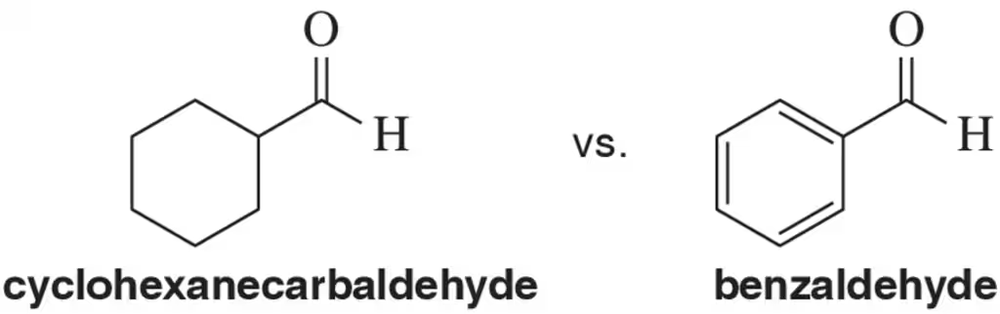
Would you expect the stretching band of the carbonyl to appear at a higher frequency for cyclohexanecarbaldehyde or benzaldehyde? Explain.
Chemical structures of cyclohexanecarbaldehyde and benzaldehyde compared side by side.

Guida verificata passo dopo passo
1
Identify the functional group responsible for the carbonyl stretching band in IR spectroscopy. In both cyclohexanecarbaldehyde and benzaldehyde, the carbonyl group (C=O) is the functional group of interest.
Understand that the frequency of the carbonyl stretching band in IR spectroscopy is influenced by the electronic environment around the carbonyl group. Factors such as conjugation, resonance, and inductive effects can alter the frequency.
Consider the structure of cyclohexanecarbaldehyde. The carbonyl group is attached to a cyclohexane ring, which is a saturated, non-aromatic ring. This means there is no resonance stabilization affecting the carbonyl group.
Examine the structure of benzaldehyde. The carbonyl group is directly attached to a benzene ring, which is an aromatic system. The resonance between the carbonyl group and the benzene ring can delocalize electrons, affecting the carbonyl stretching frequency.
Conclude that the carbonyl stretching band is expected to appear at a higher frequency in cyclohexanecarbaldehyde compared to benzaldehyde. This is because the lack of resonance stabilization in cyclohexanecarbaldehyde results in a stronger, less delocalized carbonyl bond, leading to a higher stretching frequency.

Risposta video verificata per un problema simile:

Questa soluzione video è stata consigliata dai nostri tutor come utile per risolvere questo problema.

Concetti chiave

Ecco i concetti essenziali che devi comprendere per rispondere correttamente alla domanda.

IR Spectroscopy

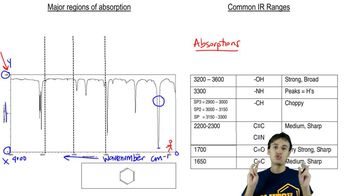
Infrared (IR) spectroscopy is a technique used to identify functional groups in organic compounds by measuring the absorption of infrared light, which causes molecular vibrations. The frequency of these vibrations is specific to certain bonds, such as the carbonyl group, and can be used to infer structural information about the molecule.
Video consigliato:
16:04
General Features of IR Spect

Carbonyl Stretching Frequency

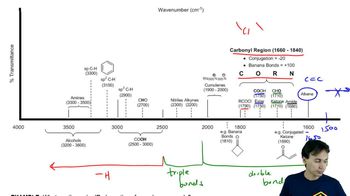
The carbonyl stretching frequency in IR spectroscopy is a key indicator of the environment around the carbonyl group. Factors such as conjugation, ring strain, and electronic effects from substituents can shift this frequency. Typically, conjugation with a benzene ring lowers the carbonyl stretching frequency due to resonance stabilization.
Video consigliato:
16:47
Common IR Frequencies

Electronic Effects in Aromatic Compounds

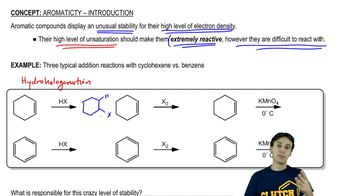
In aromatic compounds, substituents can influence electronic distribution through resonance and inductive effects. These effects can alter the electron density around functional groups like carbonyls, affecting their IR absorption frequencies. In benzaldehyde, the benzene ring can delocalize electrons, impacting the carbonyl's stretching frequency compared to non-aromatic analogs like cyclohexanecarbaldehyde.
Video consigliato:
08:19
Intro to Aromaticity