Ch. 14 - Structural Identification 1: Infrared Spectroscopy and Mass Spectrometry
Mullins - Organic Chemistry: A Learner Centered Approach 1st Edition
Mullins1st EditionOrganic Chemistry: A Learner Centered ApproachISBN: 9780137566471Non è quello che usi tu?Cambia libro di testo
Capitolo 13, Problema 68

What ratio of M, M + 2 , M + 4 and would you expect for 1,6-dibromohexane?
Structural formula of 1,6-dibromohexane, showing a six-carbon chain with bromine atoms at each end.

Guida verificata passo dopo passo
1
Understand the concept of isotopic distribution: The problem involves calculating the isotopic distribution of a molecule, specifically 1,6-dibromohexane. Bromine has two stable isotopes, Br-79 and Br-81, which will affect the mass spectrum of the compound.
Identify the molecular formula: 1,6-dibromohexane has the molecular formula C6H12Br2. This means it contains two bromine atoms, which can be either Br-79 or Br-81.
Calculate the possible mass combinations: The molecular ion peak (M) corresponds to the mass of the molecule with both bromine atoms as Br-79. The M+2 peak corresponds to one Br-79 and one Br-81, and the M+4 peak corresponds to both bromine atoms as Br-81.
Determine the relative abundance of isotopes: The natural abundance of Br-79 is approximately 50.7% and Br-81 is approximately 49.3%. Use these percentages to calculate the expected ratio of M, M+2, and M+4 peaks.
Apply the binomial distribution: Use the binomial distribution to calculate the probability of each isotopic combination. For two bromine atoms, the probabilities are: P(M) = (0.507)^2, P(M+2) = 2 * (0.507) * (0.493), and P(M+4) = (0.493)^2. This will give you the expected ratio of the peaks.

Risposta video verificata per un problema simile:

Questa soluzione video è stata consigliata dai nostri tutor come utile per risolvere questo problema.

Concetti chiave

Ecco i concetti essenziali che devi comprendere per rispondere correttamente alla domanda.

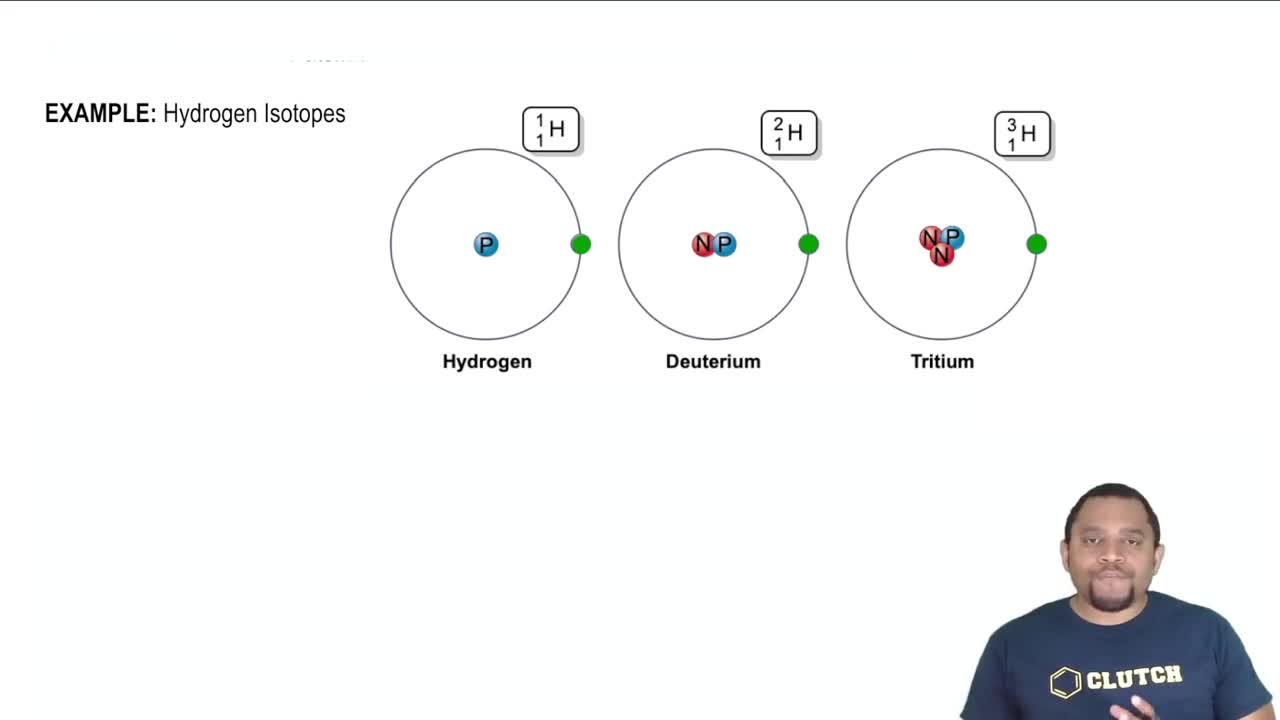
Isotopic Abundance

Isotopic abundance refers to the relative amount of each isotope of an element found in a natural sample. For bromine, the two main isotopes are Br-79 and Br-81, which occur in nearly equal abundance. This isotopic distribution is crucial for predicting the mass spectrum of compounds containing bromine, such as 1,6-dibromohexane.
Video consigliato:
03:06
Understanding the hydrogen isotopes.

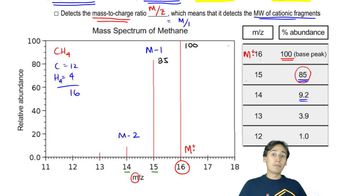
Mass Spectrometry

Mass spectrometry is an analytical technique used to measure the mass-to-charge ratio of ions. It helps in determining the molecular weight and structure of a compound. In the context of 1,6-dibromohexane, mass spectrometry can reveal the presence of isotopic peaks (M, M+2, M+4) due to the different combinations of bromine isotopes in the molecule.
Video consigliato:
01:25
How to Read a Mass Spectrum

Molecular Ion Peak

The molecular ion peak (M) in a mass spectrum represents the ionized form of the entire molecule. For 1,6-dibromohexane, the M peak corresponds to the molecule containing two Br-79 isotopes. The M+2 and M+4 peaks arise from combinations of Br-79 and Br-81 isotopes, reflecting the isotopic pattern and helping to deduce the compound's structure.
Video consigliato:
Percorso guidato
3:39
Metal Ion Catalysis Concept 1