
Ch. 15 - Structural Identification 2: Nuclear Magnetic Resonance Spectroscopy
Mullins - Organic Chemistry: A Learner Centered Approach 1st Edition
Mullins1st EditionOrganic Chemistry: A Learner Centered ApproachISBN: 9780137566471Non è quello che usi tu?Cambia libro di testo
Capitolo 14, Problema 33d

Being able to recognize patterns of integration and multiplicity for common functional groups makes structure identification more efficient. Draw the pattern of integration and multiplicity you'd expect to see for each common alkyl group.
(d) Chemical structure of t-butyl group with three CH3 groups attached to a central carbon, labeled R for the rest of the molecule.

Guida verificata passo dopo passo
1
Identify the structure of the t-butyl group, which is (CH₃)₃C−. It consists of three methyl groups attached to a central carbon atom.
Recognize that each of the three methyl groups (CH₃) in the t-butyl group is equivalent due to symmetry. This means they will produce the same NMR signal.
Determine the integration pattern: Since there are three equivalent methyl groups, the integration will correspond to 9 hydrogen atoms (3 hydrogens per methyl group times 3 methyl groups).
Consider the multiplicity: The central carbon atom in the t-butyl group does not have any hydrogens attached, so the methyl groups are not split by neighboring hydrogens. Therefore, the signal will appear as a singlet.
Summarize the expected NMR pattern for a t-butyl group: You would expect to see a singlet with an integration corresponding to 9 hydrogens in the NMR spectrum.

Risposta video verificata per un problema simile:

Questa soluzione video è stata consigliata dai nostri tutor come utile per risolvere questo problema.

Concetti chiave

Ecco i concetti essenziali che devi comprendere per rispondere correttamente alla domanda.

NMR Spectroscopy

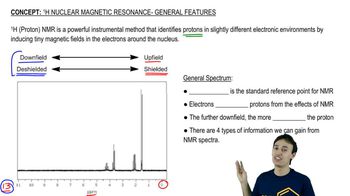
Nuclear Magnetic Resonance (NMR) spectroscopy is a technique used to determine the structure of organic compounds by analyzing the magnetic properties of atomic nuclei. It provides information about the number of hydrogen atoms (integration) and their environment (multiplicity) in a molecule, which helps in identifying functional groups and structural features.
Video consigliato:
10:06
General NMR Features

Integration in NMR

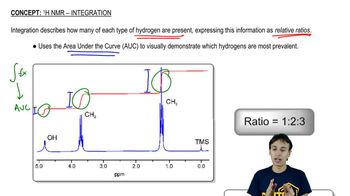
Integration in NMR refers to the area under the peaks in an NMR spectrum, which is proportional to the number of hydrogen atoms contributing to that signal. For t-butyl groups, the integration pattern typically shows a single peak corresponding to nine equivalent hydrogen atoms, indicating a symmetrical environment.
Video consigliato:
06:46
1H NMR Integration

Multiplicity in NMR

Multiplicity in NMR describes the splitting of NMR signals into multiple peaks due to spin-spin coupling between neighboring hydrogen atoms. In the case of t-butyl groups, the multiplicity is usually a singlet, as the nine equivalent hydrogens are not coupled to any adjacent hydrogens, resulting in no splitting.
Video consigliato:
10:06
General NMR Features