Ch. 15 - Structural Identification 2: Nuclear Magnetic Resonance Spectroscopy
Mullins - Organic Chemistry: A Learner Centered Approach 1st Edition
Mullins1st EditionOrganic Chemistry: A Learner Centered ApproachISBN: 9780137566471Non è quello che usi tu?Cambia libro di testo
Capitolo 14, Problema 49b

Draw the 13C NMR spectrum of each molecule in Assessment 15.48.
(b) Chemical structure of a brominated cyclic ether with a five-membered ring and a double bond in the side chain.

Guida verificata passo dopo passo
1
Identify the unique carbon environments in the molecule. Each unique environment will correspond to a different signal in the ¹³C NMR spectrum.
Consider the symmetry of the molecule. Symmetrical molecules may have fewer unique carbon environments due to equivalent positions.
Determine the chemical shift range for each type of carbon. For example, sp³ hybridized carbons typically appear between 0-50 ppm, sp² hybridized carbons between 100-150 ppm, and carbonyl carbons around 160-220 ppm.
Consider the effects of electronegative atoms or groups nearby, which can deshield carbons and shift their signals downfield (to higher ppm values).
Sketch the spectrum, placing each signal at the appropriate chemical shift based on the analysis of the carbon environments and their electronic surroundings.

Risposta video verificata per un problema simile:

Questa soluzione video è stata consigliata dai nostri tutor come utile per risolvere questo problema.

Concetti chiave

Ecco i concetti essenziali che devi comprendere per rispondere correttamente alla domanda.

¹³C NMR Spectroscopy

¹³C NMR spectroscopy is a technique used to study the carbon atoms in organic molecules. It provides information about the number of unique carbon environments in a compound by measuring the resonance frequencies of carbon-13 nuclei in a magnetic field. Each distinct carbon environment typically appears as a separate peak in the spectrum, allowing for structural analysis of the molecule.
Video consigliato:
10:06
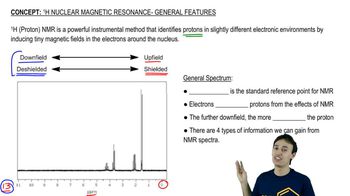
General NMR Features

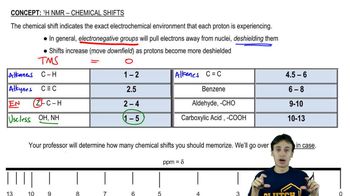
Chemical Shift

Chemical shift in NMR spectroscopy refers to the variation in the resonance frequency of a nucleus due to its electronic environment. In ¹³C NMR, chemical shifts are influenced by factors such as electronegativity of neighboring atoms and hybridization of the carbon atom. The chemical shift is measured in parts per million (ppm) and helps identify the type of carbon present in the molecule.
Video consigliato:
11:44
1H NMR Chemical Shifts

Multiplicity and Coupling

Multiplicity in NMR refers to the splitting of NMR signals into multiple peaks due to spin-spin coupling between neighboring nuclei. In ¹³C NMR, coupling with hydrogen atoms (¹H) can lead to splitting patterns, although often decoupled spectra are recorded to simplify analysis. Understanding coupling helps in deducing the connectivity and environment of carbon atoms in the molecule.
Video consigliato:
02:54
Sonogashira Coupling Reaction