

Ch. 15 - Structural Identification 2: Nuclear Magnetic Resonance Spectroscopy
Mullins - Organic Chemistry: A Learner Centered Approach 1st Edition
Mullins1st EditionOrganic Chemistry: A Learner Centered ApproachISBN: 9780137566471Non è quello che usi tu?Cambia libro di testo
Capitolo 14, Problema 78b

Given the ¹H NMR spectrum and the molecular formula, suggest a structure for each molecule. [The IR spectrum suggests the presence of two C=O bonds.]
(b) <IMAGE>

Guida verificata passo dopo passo
1
Start by analyzing the molecular formula provided. Determine the degree of unsaturation using the formula: \( \text{Degree of Unsaturation} = rac{2C + 2 + N - H - X}{2} \), where \( C \) is the number of carbons, \( N \) is the number of nitrogens, \( H \) is the number of hydrogens, and \( X \) is the number of halogens.
Examine the IR spectrum data. The presence of two \( \text{C=O} \) bonds suggests the molecule may contain functional groups such as ketones, aldehydes, or esters. Consider how these groups might fit into the molecular structure.
Analyze the \( ^1\text{H} \) NMR spectrum. Identify the number of unique hydrogen environments, their chemical shifts, and splitting patterns. This will help you deduce the connectivity and environment of hydrogen atoms in the molecule.
Consider the integration values from the \( ^1\text{H} \) NMR spectrum, which indicate the relative number of protons in each environment. Use this information to match the hydrogen environments to the molecular formula.
Combine all the information: degree of unsaturation, IR data, and \( ^1\text{H} \) NMR analysis to propose a plausible structure. Ensure that the proposed structure accounts for all spectral data and matches the molecular formula.

Risposta video verificata per un problema simile:

Questa soluzione video è stata consigliata dai nostri tutor come utile per risolvere questo problema.
Durata del video:
6m

Concetti chiave

Ecco i concetti essenziali che devi comprendere per rispondere correttamente alla domanda.

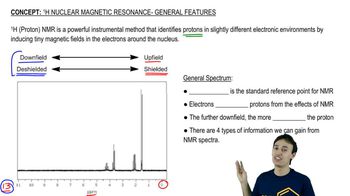
¹H NMR Spectroscopy

¹H NMR (Proton Nuclear Magnetic Resonance) spectroscopy is a technique used to determine the structure of organic compounds by analyzing the magnetic environment of hydrogen atoms. It provides information about the number of hydrogen atoms, their chemical environment, and how they are connected within a molecule. Key features include chemical shifts, multiplicity, and integration, which help deduce the molecular structure.
Video consigliato:
10:06
General NMR Features

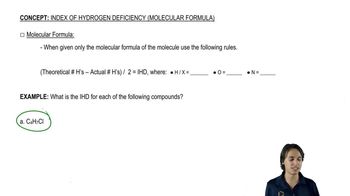
Molecular Formula Analysis

The molecular formula of a compound indicates the types and numbers of atoms present in a molecule. It is crucial for determining possible structures by providing the elemental composition. When combined with spectroscopic data, the molecular formula helps narrow down structural possibilities by ensuring that the proposed structure matches the given atomic composition and degree of unsaturation.
Video consigliato:
02:17
How to use IHD with molecular formula.

IR Spectroscopy and Functional Groups

Infrared (IR) spectroscopy is used to identify functional groups within a molecule by measuring the absorption of infrared light, which causes molecular vibrations. The presence of specific absorption bands, such as those for carbonyl (C=O) groups, can confirm the existence of certain functional groups. In this context, the IR spectrum indicating two C=O bonds suggests the presence of functional groups like ketones, aldehydes, or carboxylic acids, guiding the structural determination.
Video consigliato:
02:36
Identifying Functional Groups