Ch. 16 - Metals in Organic Chemistry
Mullins - Organic Chemistry: A Learner Centered Approach 1st Edition
Mullins1st EditionOrganic Chemistry: A Learner Centered ApproachISBN: 9780137566471Non è quello che usi tu?Cambia libro di testo
Capitolo 15, Problema 42

Which of the following solvents are reasonable choices for a Grignard reaction? Justify your choices. [Hint: Carbonyls are good electrophiles.]
Chemical structures of a cyclic ether, a carbonyl compound, an alcohol, and a carbonyl compound with an alkyl group.

Guida verificata passo dopo passo
1
Grignard reagents are highly reactive organomagnesium compounds that are sensitive to moisture and protic solvents. Therefore, the choice of solvent is crucial for the success of a Grignard reaction.
The first structure is tetrahydrofuran (THF), a cyclic ether. Ethers are generally good solvents for Grignard reactions because they can stabilize the Grignard reagent through coordination with the oxygen atom, and they do not contain acidic protons that would react with the Grignard reagent.
The second structure is ethyl acetate, an ester. Esters are not suitable solvents for Grignard reactions because they contain a carbonyl group, which is a good electrophile and would react with the Grignard reagent, leading to unwanted side reactions.
The third structure is ethanol, an alcohol. Alcohols are protic solvents and contain acidic protons that would react with the Grignard reagent, destroying it. Therefore, ethanol is not a suitable solvent for Grignard reactions.
The fourth structure is diethyl ether, a common solvent for Grignard reactions. Like THF, diethyl ether is an aprotic solvent that can stabilize the Grignard reagent without reacting with it. It is often used in Grignard reactions due to its ability to dissolve both the Grignard reagent and the organic substrate.

Risposta video verificata per un problema simile:

Questa soluzione video è stata consigliata dai nostri tutor come utile per risolvere questo problema.

Concetti chiave

Ecco i concetti essenziali che devi comprendere per rispondere correttamente alla domanda.

Grignard Reagents

Grignard reagents are organomagnesium compounds that are highly reactive and serve as nucleophiles in organic synthesis. They are formed by reacting alkyl or aryl halides with magnesium metal in anhydrous ether. Their reactivity allows them to attack electrophiles, such as carbonyl compounds, making them essential in forming new carbon-carbon bonds.
Video consigliato:
02:12
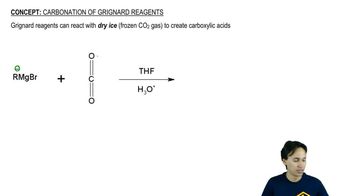
Carbonation of Grignard Reagents

Solvent Properties

The choice of solvent in a Grignard reaction is critical because Grignard reagents are sensitive to moisture and can react with protic solvents, leading to their decomposition. Suitable solvents are typically non-polar and aprotic, such as diethyl ether or tetrahydrofuran (THF), which can stabilize the Grignard reagent without participating in the reaction.
Video consigliato:
01:16
Identification of polarity in solvents

Electrophilicity of Carbonyls

Carbonyl compounds, such as aldehydes and ketones, are good electrophiles due to the polarized carbon-oxygen double bond, where the carbon atom carries a partial positive charge. This makes them susceptible to nucleophilic attack by Grignard reagents, facilitating the formation of alcohols after subsequent hydrolysis. Understanding this reactivity is crucial for predicting the outcomes of Grignard reactions.
Video consigliato:
04:20
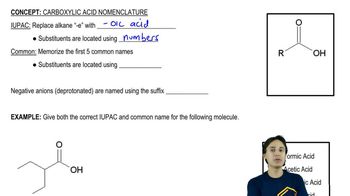
Carboxylic Acids Nomenclature