Ch. 17 - Carbonyl Addition Reactions: Aldehydes and Ketones
Mullins - Organic Chemistry: A Learner Centered Approach 1st Edition
Mullins1st EditionOrganic Chemistry: A Learner Centered ApproachISBN: 9780137566471Non è quello che usi tu?Cambia libro di testo
Capitolo 16, Problema 20b

Suggest an acetylide ion and a carbonyl that might be used to make the following products.
(b) 2,6-dimethylhept-3-yn-2-ol

Guida verificata passo dopo passo
1
Identify the structure of the target molecule, 2,6-dimethylhept-3-yn-2-ol. It contains a terminal alcohol group (-OH) at carbon 2, a triple bond between carbons 3 and 4, and methyl groups attached to carbons 2 and 6.
Recall that acetylide ions (R-C≡C⁻) are strong nucleophiles that can attack electrophilic carbonyl carbons (C=O) to form alcohols after protonation. The triple bond in the product suggests the use of an acetylide ion.
Break the target molecule into two fragments: (1) the acetylide ion and (2) the carbonyl compound. The bond between the carbon bearing the alcohol group (C2) and the adjacent carbon (C3) is likely formed during the reaction.
Determine the acetylide ion: The fragment containing the triple bond and the terminal carbon (C≡C-CH(CH₃)₂) corresponds to the acetylide ion. This is derived from 2-methylbut-1-yne by deprotonation with a strong base like NaNH₂.
Determine the carbonyl compound: The remaining fragment, a ketone, corresponds to 3-methylbutan-2-one. This ketone reacts with the acetylide ion in a nucleophilic addition reaction to form the target alcohol after protonation.

Risposta video verificata per un problema simile:

Questa soluzione video è stata consigliata dai nostri tutor come utile per risolvere questo problema.
Durata del video:
4m

Concetti chiave

Ecco i concetti essenziali che devi comprendere per rispondere correttamente alla domanda.

Acetylide Ion

An acetylide ion is a negatively charged species formed by deprotonating a terminal alkyne. It is a strong nucleophile, capable of attacking electrophilic carbon centers, such as those found in carbonyl compounds. In organic synthesis, acetylide ions are often used to form carbon-carbon bonds, making them essential for constructing complex molecules.
Video consigliato:
Percorso guidato
3:39
Metal Ion Catalysis Concept 1

Carbonyl Compounds

Carbonyl compounds contain a carbon atom double-bonded to an oxygen atom (C=O). They include aldehydes, ketones, and carboxylic acids, and are key intermediates in organic synthesis. The electrophilic nature of the carbonyl carbon allows it to react with nucleophiles, such as acetylide ions, facilitating the formation of alcohols and other functional groups.
Video consigliato:
01:40
Defining meso compounds.

Synthesis of Alcohols

The synthesis of alcohols from carbonyl compounds typically involves nucleophilic addition reactions. When an acetylide ion attacks a carbonyl carbon, it forms an alkoxide intermediate, which can be protonated to yield an alcohol. This reaction is fundamental in organic chemistry for constructing alcohols with specific carbon skeletons, such as the target compound in the question.
Video consigliato:
02:26
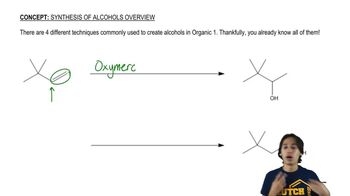
Forming alcohols through Oxymercuration-Reduction.