Ch. 17 - Carbonyl Addition Reactions: Aldehydes and Ketones
Mullins - Organic Chemistry: A Learner Centered Approach 1st Edition
Mullins1st EditionOrganic Chemistry: A Learner Centered ApproachISBN: 9780137566471Non è quello che usi tu?Cambia libro di testo
Capitolo 16, Problema 26a

Suggest the appropriate carbonyl and Wittig reagent to make the following alkenes.
a. (E)-7-methylnon-4-en-3-one

Guida verificata passo dopo passo
1
Step 1: Understand the Wittig reaction, which involves the reaction of a phosphonium ylide with a carbonyl compound to form an alkene. The ylide is typically formed from a triphenylphosphine and an alkyl halide.
Step 2: Identify the target alkene structure, (E)-7-methylnon-4-en-3-one. Note the position of the double bond and the stereochemistry (E configuration).
Step 3: Determine the carbonyl compound needed. The Wittig reaction forms the double bond at the site of the carbonyl group. For (E)-7-methylnon-4-en-3-one, the carbonyl group should be at the 3-position, suggesting the use of 3-oxononanal as the carbonyl compound.
Step 4: Identify the Wittig reagent. The Wittig reagent should provide the remaining carbon chain that forms the alkene. For (E)-7-methylnon-4-en-3-one, the Wittig reagent should be a phosphonium ylide derived from 4-methylbutyltriphenylphosphonium bromide.
Step 5: Consider the stereochemistry. The (E) configuration indicates that the Wittig reaction should be controlled to favor the trans product. This can be influenced by the choice of base and reaction conditions.

Risposta video verificata per un problema simile:

Questa soluzione video è stata consigliata dai nostri tutor come utile per risolvere questo problema.
Durata del video:
4m

Concetti chiave

Ecco i concetti essenziali che devi comprendere per rispondere correttamente alla domanda.

Wittig Reaction

The Wittig reaction is a chemical reaction used to convert carbonyl compounds, such as aldehydes and ketones, into alkenes. This transformation involves the reaction of a phosphonium ylide with a carbonyl compound, resulting in the formation of a new carbon-carbon double bond. Understanding the mechanism and the stereochemistry of the Wittig reaction is crucial for predicting the structure of the resulting alkene.
Video consigliato:
15:39
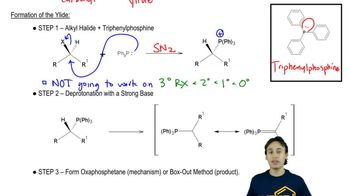
Box-Out Method and Full-Mechanism

Carbonyl Compounds

Carbonyl compounds are organic molecules that contain a carbon-oxygen double bond. They are key intermediates in many organic reactions, including the Wittig reaction. In the context of synthesizing alkenes, selecting the appropriate carbonyl compound is essential, as it determines the position and configuration of the double bond in the final alkene product.
Video consigliato:
01:40
Defining meso compounds.

Stereochemistry of Alkenes

Stereochemistry refers to the spatial arrangement of atoms in molecules and its impact on the physical and chemical properties of compounds. In alkenes, stereochemistry is particularly important because it affects the E/Z configuration of the double bond. For the synthesis of (E)-7-methylnon-4-en-3-one, understanding how to control and predict the stereochemistry during the Wittig reaction is crucial for obtaining the desired (E)-isomer.
Video consigliato:
Percorso guidato
1:38
Polymer Stereochemistry Concept 1