Ch. 2 - General Chemistry Translated: Finding the Electrons
Mullins - Organic Chemistry: A Learner Centered Approach 1st Edition
Mullins1st EditionOrganic Chemistry: A Learner Centered ApproachISBN: 9780137566471Non è quello che usi tu?Cambia libro di testo
Capitolo 1, Problema 70a,b

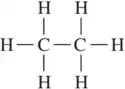
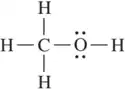
Refer to the following Lewis structures.
(a) Structural formula of ethane showing carbon and hydrogen atoms with bonds.
(b) Structural formula of a molecule showing carbon and oxygen atoms with hydrogen atoms, indicating hybridization.
Predict the hybridization of all non-hydrogen atoms.

Guida verificata passo dopo passo
1
Step 1: Understand the concept of hybridization. Hybridization is the mixing of atomic orbitals to form new hybrid orbitals that are suitable for bonding. The type of hybridization depends on the number of electron domains (bonding pairs and lone pairs) around the atom.
Step 2: Examine the Lewis structures provided in the problem. Identify all non-hydrogen atoms and count the number of electron domains around each atom. Electron domains include single bonds, double bonds, triple bonds, and lone pairs.
Step 3: Use the electron domain count to determine the hybridization. For example: (a) 2 electron domains = sp hybridization, (b) 3 electron domains = sp² hybridization, (c) 4 electron domains = sp³ hybridization.
Step 4: Apply the hybridization rules to each non-hydrogen atom in the Lewis structures. For example, if a carbon atom has 4 single bonds, it will have sp³ hybridization. If a carbon atom has a double bond and two single bonds, it will have sp² hybridization.
Step 5: Summarize the hybridization for all non-hydrogen atoms in the Lewis structures. Ensure that lone pairs are also considered when counting electron domains, as they contribute to the hybridization.

Risposta video verificata per un problema simile:

Questa soluzione video è stata consigliata dai nostri tutor come utile per risolvere questo problema.
Durata del video:
3m

Concetti chiave

Ecco i concetti essenziali che devi comprendere per rispondere correttamente alla domanda.

Lewis Structures

Lewis structures are diagrams that represent the bonding between atoms in a molecule and the lone pairs of electrons that may exist. They provide a visual way to understand the arrangement of electrons and how atoms are connected, which is crucial for predicting molecular geometry and reactivity.
Video consigliato:
04:12
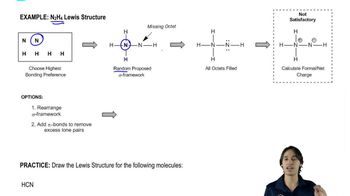
Drawing the Lewis Structure for N2H4.

Hybridization

Hybridization is the concept of mixing atomic orbitals to form new hybrid orbitals that can accommodate the bonding requirements of atoms in a molecule. The type of hybridization (e.g., sp, sp2, sp3) determines the geometry of the molecule and the angles between bonds, which are essential for understanding molecular shape and reactivity.
Video consigliato:
10:43
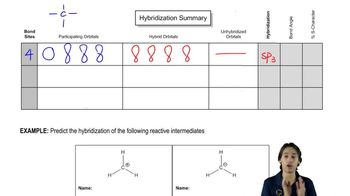
Using bond sites to predict hybridization

Non-Hydrogen Atoms

In organic chemistry, non-hydrogen atoms typically refer to carbon, nitrogen, oxygen, and other elements that form the backbone of organic molecules. Understanding the hybridization of these atoms is critical for predicting how they will interact with each other and with hydrogen, influencing the overall structure and properties of the compound.
Video consigliato:
03:06
Understanding the hydrogen isotopes.