Ch. 2 - General Chemistry Translated: Finding the Electrons
Mullins - Organic Chemistry: A Learner Centered Approach 1st Edition
Mullins1st EditionOrganic Chemistry: A Learner Centered ApproachISBN: 9780137566471Non è quello che usi tu?Cambia libro di testo
Capitolo 1, Problema 47b

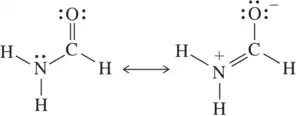
Each pair of structures represents two valid resonance structures. Use the arrow-pushing formalism to justify the formation of the one on the left from the one on the right.
(b) Two resonance structures of a molecule with arrows indicating electron movement between them.

Guida verificata passo dopo passo
1
Identify the key differences between the two resonance structures. Look for changes in bond placement, lone pairs, or formal charges.
Determine the movement of electrons that would convert the structure on the right into the structure on the left. This typically involves the movement of π-electrons or lone pairs.
Use curved arrows to represent the electron flow. For example, if a lone pair moves to form a π-bond, draw an arrow from the lone pair to the bond location. If a π-bond moves to form a lone pair, draw an arrow from the bond to the atom where the lone pair will reside.
Ensure that the formal charges are correctly updated after the electron movement. For example, if an atom loses a lone pair, its formal charge will become more positive, and if it gains a lone pair, its formal charge will become more negative.
Verify that the resulting structure on the left adheres to the rules of resonance: all atoms must have valid octets (if applicable), and the overall charge of the molecule must remain the same.

Risposta video verificata per un problema simile:

Questa soluzione video è stata consigliata dai nostri tutor come utile per risolvere questo problema.
Durata del video:
3m

Concetti chiave

Ecco i concetti essenziali che devi comprendere per rispondere correttamente alla domanda.

Resonance Structures

Resonance structures are different Lewis structures for the same molecule that depict the same arrangement of atoms but differ in the distribution of electrons. These structures help illustrate the delocalization of electrons within a molecule, which can stabilize it. The actual structure of the molecule is a hybrid of all possible resonance forms, contributing to its overall stability and reactivity.
Video consigliato:
03:04
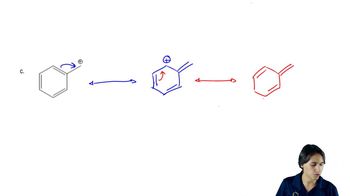
Drawing Resonance Structures

Arrow-Pushing Formalism

Arrow-pushing formalism is a method used in organic chemistry to depict the movement of electrons during chemical reactions. Curved arrows indicate the direction of electron flow, showing how bonds are formed or broken. This technique is essential for visualizing mechanisms and understanding how resonance structures interconvert, as it clarifies the changes in electron density and bond formation.
Video consigliato:
01:34
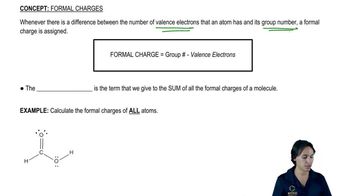
Calculating formal and net charge.

Electron Delocalization

Electron delocalization refers to the distribution of electrons across multiple atoms in a molecule, rather than being localized between two specific atoms. This phenomenon is crucial in resonance structures, as it allows for the stabilization of the molecule by spreading out electron density. Delocalization can affect the reactivity and properties of compounds, making it a key concept in understanding molecular behavior.
Video consigliato:
03:54
The 18 and 16 Electron Rule