Ch. 2 - General Chemistry Translated: Finding the Electrons
Mullins - Organic Chemistry: A Learner Centered Approach 1st Edition
Mullins1st EditionOrganic Chemistry: A Learner Centered ApproachISBN: 9780137566471Non è quello che usi tu?Cambia libro di testo
Capitolo 1, Problema 1d

Give the electron configuration of the following elements.
(d) F

Guida verificata passo dopo passo
1
Step 1: Understand the concept of electron configuration. Electron configuration describes the arrangement of electrons in an atom's orbitals, following the principles of the Aufbau principle, Hund's rule, and the Pauli exclusion principle.
Step 2: Determine the atomic number of fluorine (F). Fluorine has an atomic number of 9, which means it has 9 electrons in its neutral state.
Step 3: Fill the orbitals according to the Aufbau principle, which states that electrons occupy the lowest energy orbitals first. The order of filling is: 1s, 2s, 2p, 3s, 3p, etc.
Step 4: Assign the electrons to the orbitals. Start with the 1s orbital, which can hold up to 2 electrons. Then move to the 2s orbital, which also holds 2 electrons. Finally, place the remaining 5 electrons in the 2p orbital, which can hold up to 6 electrons.
Step 5: Write the electron configuration for fluorine. Using the format of subshell notation (e.g., \(1s^2\), \(2s^2\), \(2p^5\)), the electron configuration for fluorine is \(1s^2\ 2s^2\ 2p^5\).

Risposta video verificata per un problema simile:

Questa soluzione video è stata consigliata dai nostri tutor come utile per risolvere questo problema.
Durata del video:
3m

Concetti chiave

Ecco i concetti essenziali che devi comprendere per rispondere correttamente alla domanda.

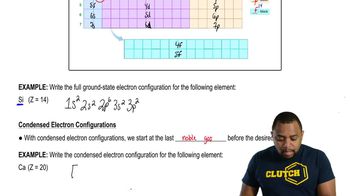
Electron Configuration

Electron configuration describes the distribution of electrons in an atom's orbitals. It follows the Aufbau principle, which states that electrons fill the lowest energy orbitals first, and is typically represented using a notation that indicates the energy levels and sublevels occupied by electrons.
Video consigliato:
02:14
The Electron Configuration

Periodic Table and Element Properties

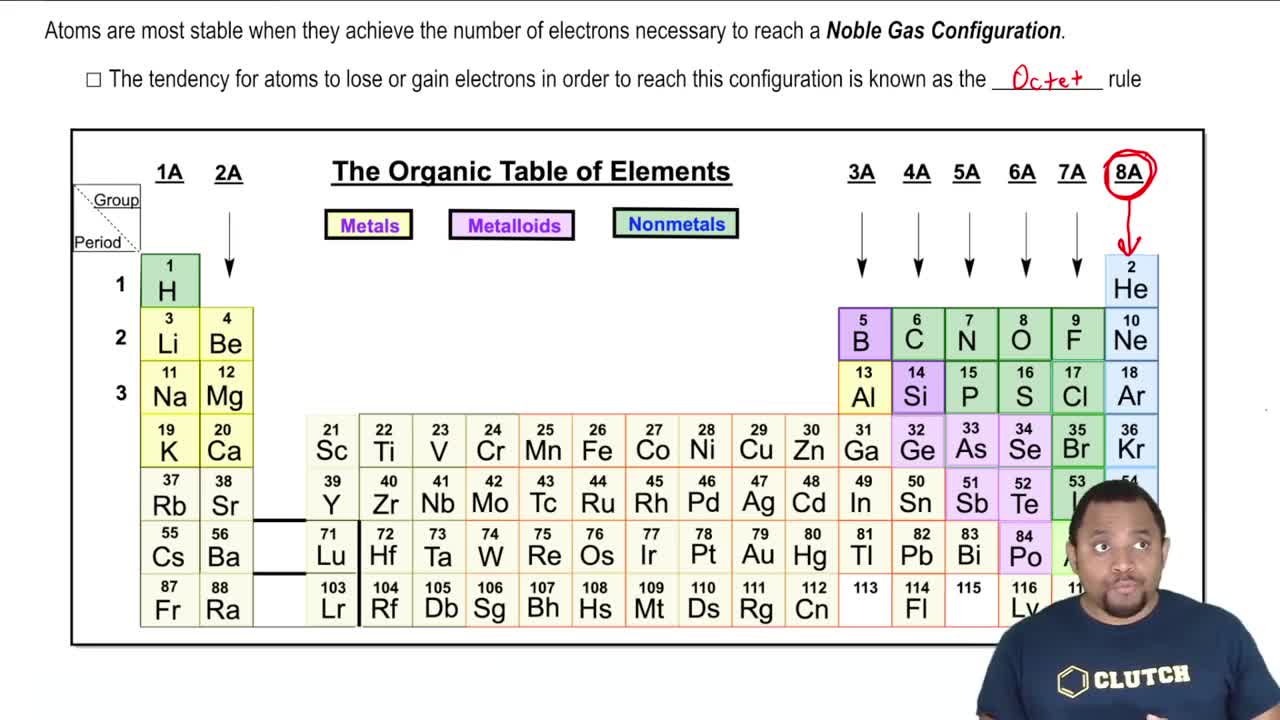
The periodic table organizes elements based on their atomic number and electron configurations, which influence their chemical properties. Understanding an element's position in the periodic table helps predict its electron configuration, as elements in the same group often have similar configurations.
Video consigliato:
02:24
The most important parts of the periodic table for organic chemistry

Fluorine's Atomic Structure

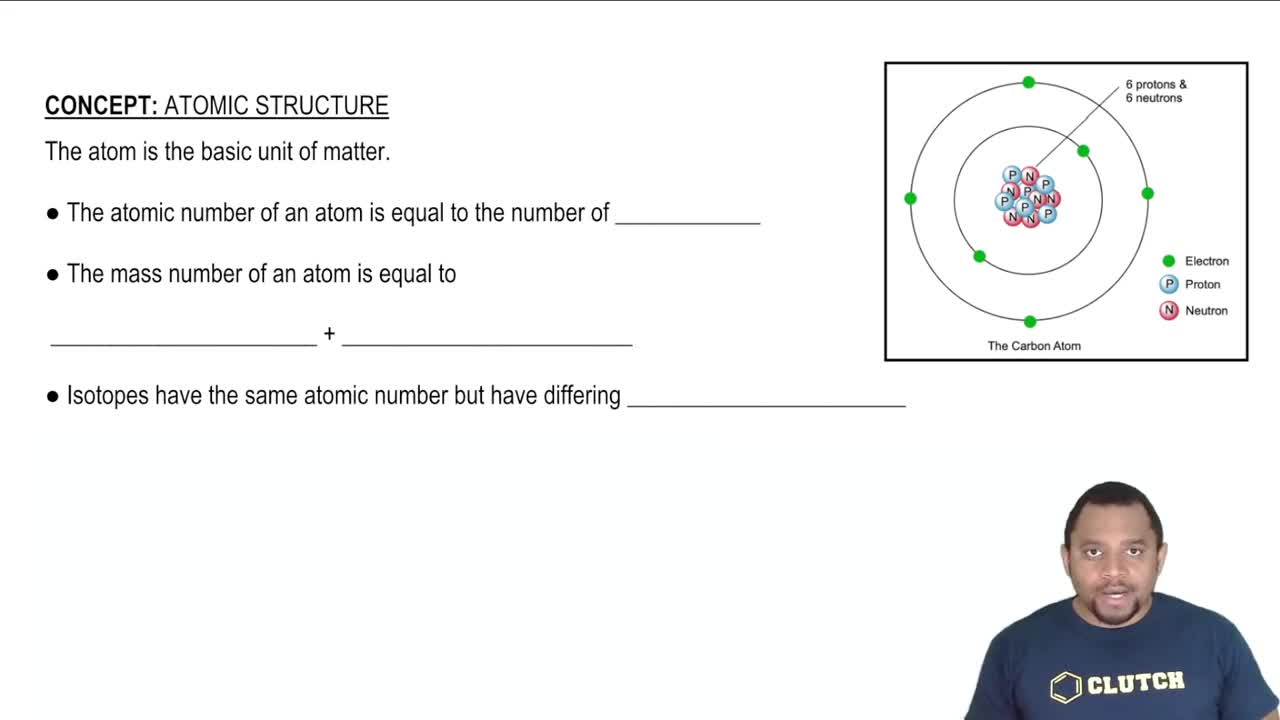
Fluorine (F) has an atomic number of 9, meaning it has 9 electrons. Its electron configuration is 1s² 2s² 2p⁵, indicating that it has two electrons in the first energy level and seven in the second, which is crucial for understanding its reactivity and placement in the halogen group.
Video consigliato:
01:44
The difference between atomic numbers and atomic mass.