Ch. 2 - General Chemistry Translated: Finding the Electrons
Mullins - Organic Chemistry: A Learner Centered Approach 1st Edition
Mullins1st EditionOrganic Chemistry: A Learner Centered ApproachISBN: 9780137566471Non è quello che usi tu?Cambia libro di testo
Capitolo 1, Problema 77b

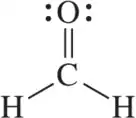
Given the Lewis structures, indicate the direction of the dipole moment, if there is one.
(b) Lewis structure of a molecule showing oxygen and carbon atoms, with hydrogen atoms, indicating dipole moment direction.

Guida verificata passo dopo passo
1
Examine the given Lewis structure and identify the atoms involved in the bond(s) of interest. Determine the electronegativity of each atom using the periodic table.
Recall that the dipole moment arises due to a difference in electronegativity between two bonded atoms. The more electronegative atom will pull the shared electrons closer to itself, creating a partial negative charge (δ⁻), while the less electronegative atom will have a partial positive charge (δ⁺).
Using the electronegativity values, determine the direction of the dipole moment. The dipole moment vector points from the less electronegative atom (δ⁺) to the more electronegative atom (δ⁻).
Draw an arrow on the Lewis structure to represent the dipole moment. The tail of the arrow should be at the less electronegative atom, and the head of the arrow (with a small cross at the tail) should point toward the more electronegative atom.
If the molecule contains multiple bonds with dipole moments, consider the geometry of the molecule to determine whether the dipole moments cancel out or add together to form a net dipole moment. Use VSEPR theory to assess the molecular shape if needed.

Risposta video verificata per un problema simile:

Questa soluzione video è stata consigliata dai nostri tutor come utile per risolvere questo problema.
Durata del video:
5m

Concetti chiave

Ecco i concetti essenziali che devi comprendere per rispondere correttamente alla domanda.

Lewis Structures

Lewis structures are diagrams that represent the bonding between atoms in a molecule and the lone pairs of electrons that may exist. They help visualize the arrangement of electrons and the connectivity of atoms, which is crucial for understanding molecular geometry and polarity. By analyzing these structures, one can determine how electrons are distributed, which influences the dipole moment.
Video consigliato:
04:12
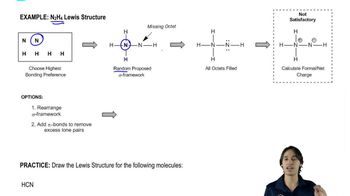
Drawing the Lewis Structure for N2H4.

Dipole Moment

The dipole moment is a vector quantity that measures the separation of positive and negative charges in a molecule. It is represented by the symbol 'μ' and is calculated as the product of the charge and the distance between the charges. A molecule has a dipole moment if it has polar bonds and an asymmetrical shape, indicating that there is a net dipole in a specific direction.
Video consigliato:
01:46
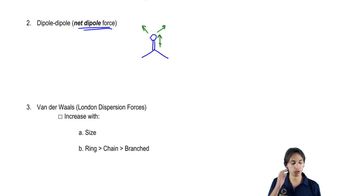
How dipole-dipole forces work.

Polarity of Molecules

Polarity refers to the distribution of electrical charge over the atoms in a molecule. A polar molecule has a significant difference in electronegativity between its atoms, leading to an uneven distribution of electron density. Understanding polarity is essential for predicting the behavior of molecules in electric fields and their interactions with other substances, including solubility and reactivity.
Video consigliato:
2:04
Molecular Polarity