The dye alizarin normally forms an orange solution when dissolved. However, if KOEt is added to the solution, it turns blue very rapidly. Rationalize this result.
Ch. 21 - Conjugated Systems 1: Stability and Addition Reactions

Mullins1st EditionOrganic Chemistry: A Learner Centered ApproachISBN: 9780137566471Non è quello che usi tu?Cambia libro di testo
Tutti i libri di testo
Mullins 1st Edition
Ch. 21 - Conjugated Systems 1: Stability and Addition Reactions
Problema 57j
Mullins 1st Edition
Ch. 21 - Conjugated Systems 1: Stability and Addition Reactions
Problema 57jCapitolo 20, Problema 57j
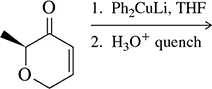
Predict the product of the following reactions.
(j) 
Guida verificata passo dopo passo1
Identify the type of reaction taking place. Common types include substitution, addition, elimination, and rearrangement reactions. Understanding the reaction type will guide you in predicting the product.
Examine the reactants involved in the reaction. Look for functional groups, stereochemistry, and any other relevant structural features that might influence the reaction pathway.
Consider the reaction conditions provided, such as temperature, solvent, and catalysts. These conditions can significantly affect the mechanism and outcome of the reaction.
Apply the appropriate reaction mechanism based on the type of reaction and the conditions. For example, if it's a nucleophilic substitution, determine whether it follows an SN1 or SN2 mechanism.
Predict the product by following the steps of the mechanism. Ensure to account for any stereochemical changes, rearrangements, or formation of intermediates that might occur during the reaction.

Risposta video verificata per un problema simile:
Questa soluzione video è stata consigliata dai nostri tutor come utile per risolvere questo problema.
Durata del video:
1mConcetti chiave
Ecco i concetti essenziali che devi comprendere per rispondere correttamente alla domanda.
Reaction Mechanism
Understanding the reaction mechanism is crucial for predicting the product of a chemical reaction. It involves identifying the step-by-step sequence of elementary reactions that lead to the formation of the product. This includes recognizing intermediates, transition states, and the role of catalysts or reagents in facilitating the reaction.
Video consigliato:
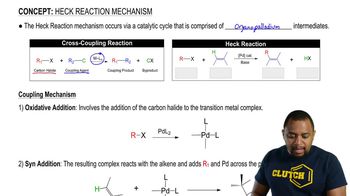
Heck Reaction Mechanism
Functional Groups
Functional groups are specific groups of atoms within molecules that are responsible for the characteristic chemical reactions of those molecules. Recognizing the functional groups involved in a reaction helps predict the type of reaction that will occur, such as addition, substitution, or elimination, and thus the nature of the product formed.
Video consigliato:
Identifying Functional Groups
Regioselectivity and Stereoselectivity
Regioselectivity refers to the preference of a chemical reaction to occur at one direction or position over another, while stereoselectivity involves the formation of a specific stereoisomer when multiple are possible. These concepts are essential for predicting the major product in reactions where multiple outcomes are possible, ensuring the correct spatial arrangement and connectivity of atoms.
Video consigliato:
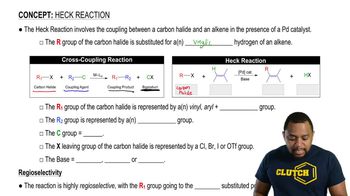
Heck Reaction
Pratica correlata
Domanda del libro di testo
1095
views
Domanda del libro di testo
Predict the product of the following reactions.
(d)
1055
views
Domanda del libro di testo
The reactivity of cyclopropanes often mimics that of alkenes.
(a) On the basis of this, suggest a mechanism for the following reaction.
468
views
Domanda del libro di testo
The reactivity of cyclopropanes often mimics that of alkenes.
(b) Besides opening the three-membered ring, what is the driving force for this reaction?
1013
views
Domanda del libro di testo
In Chapter 9, electron-rich alkenes were oxidized under acidic conditions with mCPBA. Conjugated alkenes can be oxidized using the same reagent, but under basic conditions. Suggest a mechanism for this reaction. [Think about what is electron-rich and what is electron-poor in the reaction. Also, identify the bonds formed and broken.]
1082
views
Domanda del libro di testo
Predict the product of the following reactions.
(i)
1044
views