Ch. 21 - Conjugated Systems 1: Stability and Addition Reactions
Mullins - Organic Chemistry: A Learner Centered Approach 1st Edition
Mullins1st EditionOrganic Chemistry: A Learner Centered ApproachISBN: 9780137566471Non è quello che usi tu?Cambia libro di testo
Capitolo 20, Problema 36a,b,c

Would you expect the following nucleophiles to do 1,2- or 1,4-addition?
(a)
(b)
(c) HO–

Guida verificata passo dopo passo
1
Identify the type of nucleophile: The nucleophiles provided are a phenyl lithium compound, a tert-butyl lithium compound, and hydroxide ion (HO–). These are strong nucleophiles and bases.
Understand the concept of 1,2- and 1,4-addition: In conjugated systems, nucleophiles can add to the carbonyl carbon (1,2-addition) or to the beta carbon (1,4-addition). The choice depends on the nucleophile's strength and steric factors.
Analyze the phenyl lithium compound: This nucleophile is strong and typically favors 1,2-addition due to its ability to directly attack the carbonyl carbon.
Consider the tert-butyl lithium compound: Being a bulky nucleophile, it may prefer 1,4-addition to avoid steric hindrance at the carbonyl carbon.
Evaluate the hydroxide ion (HO–): As a strong nucleophile, it generally favors 1,2-addition, attacking the carbonyl carbon directly.

Risposta video verificata per un problema simile:

Questa soluzione video è stata consigliata dai nostri tutor come utile per risolvere questo problema.

Concetti chiave

Ecco i concetti essenziali che devi comprendere per rispondere correttamente alla domanda.

Nucleophilicity

Nucleophilicity refers to the ability of a nucleophile to donate an electron pair to an electrophile during a chemical reaction. Stronger nucleophiles are more likely to participate in reactions, influencing whether a 1,2- or 1,4-addition occurs. Factors affecting nucleophilicity include charge, electronegativity, and steric hindrance.
Video consigliato:
08:27
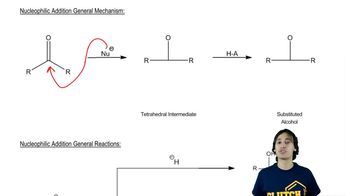
Nucleophilic Addition

1,2- and 1,4-Addition Mechanisms

1,2- and 1,4-addition mechanisms describe how nucleophiles add to conjugated systems, such as α,β-unsaturated carbonyl compounds. In 1,2-addition, the nucleophile attacks the carbonyl carbon, while in 1,4-addition, it attacks the β-carbon. The stability of the intermediate and the nature of the nucleophile often dictate which pathway is favored.
Video consigliato:
05:39
Features of Addition Mechanisms.

Electrophilic Sites

Electrophilic sites are regions in a molecule that are electron-deficient and can attract nucleophiles. In the context of 1,2- and 1,4-addition, the carbonyl carbon and the β-carbon of an α,β-unsaturated carbonyl compound serve as electrophilic sites. Understanding these sites is crucial for predicting the outcome of nucleophilic additions.
Video consigliato:
03:
Nucleophile or Electrophile