Ch. 22 - Conjugated Systems 2: Pericyclic Reactions
Mullins - Organic Chemistry: A Learner Centered Approach 1st Edition
Mullins1st EditionOrganic Chemistry: A Learner Centered ApproachISBN: 9780137566471Non è quello che usi tu?Cambia libro di testo
Capitolo 21, Problema 10

Diene A participates in a fast and efficient Diels–Alder reaction with maleic anhydride, the powerful dienophile from Assessment 22.9. However, the related diene B does not undergo a Diels–Alder reaction. Why?
Diene A reacts with maleic anhydride in a fast Diels-Alder reaction; diene B does not react.

Guida verificata passo dopo passo
1
Identify the structural features of diene A and diene B. Diene A should have a conjugated system of double bonds, which is necessary for the Diels–Alder reaction. Diene B may lack this feature.
Examine the stereochemistry and conformation of diene A. For a Diels–Alder reaction to occur, the diene must be in an s-cis conformation, allowing the p orbitals to overlap effectively with the dienophile.
Analyze the electronic properties of diene A and diene B. Diene A should have electron-rich double bonds, which are more reactive towards the electron-poor dienophile, maleic anhydride.
Consider any steric hindrance in diene B that might prevent it from adopting the necessary s-cis conformation or from effectively interacting with the dienophile.
Conclude that diene B does not undergo the Diels–Alder reaction due to its inability to meet one or more of the necessary conditions: lack of conjugation, improper conformation, unfavorable electronic properties, or steric hindrance.

Risposta video verificata per un problema simile:

Questa soluzione video è stata consigliata dai nostri tutor come utile per risolvere questo problema.

Concetti chiave

Ecco i concetti essenziali che devi comprendere per rispondere correttamente alla domanda.

Diels–Alder Reaction

The Diels–Alder reaction is a [4+2] cycloaddition between a conjugated diene and a dienophile, forming a six-membered ring. It is a pericyclic reaction that occurs via a concerted mechanism, requiring the diene to be in an s-cis conformation for effective overlap of p-orbitals. This reaction is stereospecific and often used in synthetic organic chemistry to construct complex cyclic structures.
Video consigliato:
04:02
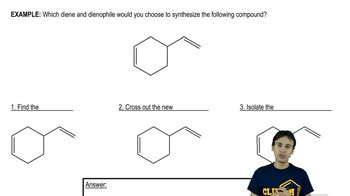
Diels-Alder Retrosynthesis

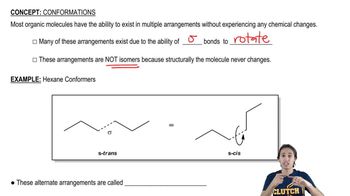
Conformation of Dienes

Dienes can exist in s-cis or s-trans conformations, which significantly affect their reactivity in Diels–Alder reactions. The s-cis conformation allows the diene's p-orbitals to align properly with the dienophile, facilitating the cycloaddition. If a diene is locked in an s-trans conformation or cannot easily adopt the s-cis conformation, it will not participate effectively in the Diels–Alder reaction.
Video consigliato:
03:29
Understanding what a conformer is.

Electronic Effects in Dienes

The electronic nature of a diene influences its reactivity in Diels–Alder reactions. Electron-rich dienes are more reactive as they can better interact with electron-deficient dienophiles like maleic anhydride. Substituents on the diene can alter its electron density, affecting its ability to participate in the reaction. Diene B may lack the necessary electronic properties or conformation to react with maleic anhydride.
Video consigliato:
04:29
Activity and Directing Effects